After years of rising prices, plenty of people would love to see them fall. So it comes as a surprise that the people in charge of money treat falling prices as a danger, not a reward. That isn’t perversity. When prices fall across a whole economy and keep falling, the effects spread into wages, jobs and debts in ways that hurt the same households who hoped to benefit. Here is how that works, in plain language.
Ask almost anyone what they want from the economy and “lower prices” will be near the top of the list. Groceries, rent, energy — after the squeeze of recent years, the idea of all of it getting cheaper sounds like relief. Yet central banks aim for prices that rise slowly, not prices that fall. To many people that looks like a choice made for someone else’s benefit. It isn’t, and once you see the mechanics, the reason is surprisingly down to earth.
Two very different kinds of “cheaper”
Start by separating two things that sound alike. When one product gets cheaper — a television, a flight, a phone — that is a change in relative prices. Something became easier to make, or competition got fiercer, and the rest of your budget is untouched. That kind of falling price is mostly good news, and it happens all the time.
Deflation is something else: a fall in the general price level, the average across nearly everything an economy buys and sells, sustained over time. It is the mirror image of inflation. And it matters to separate it from a third idea people often mean when they hope prices will “come back down”: slower inflation. When inflation drops from high to low, prices are still rising, just more gently. Prices actually falling, across the board, year after year, is a different and much rarer situation, and that is the one this piece is about.
The key point to hold onto: in a deflation, it isn’t only the things you buy that get cheaper. Prices include wages, rents landlords receive, and the revenues businesses earn. Your income is someone else’s price.
The waiting game
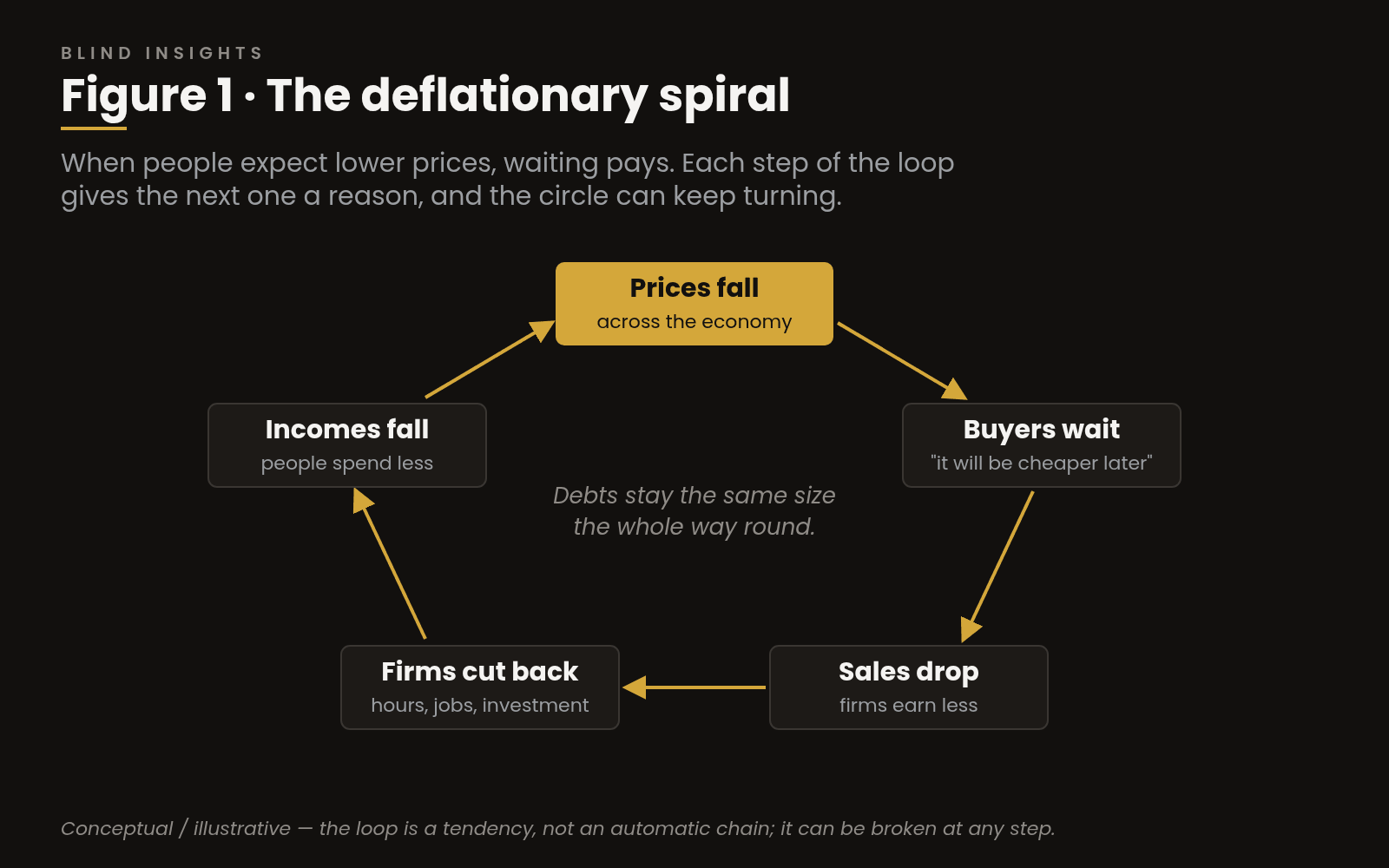
Here is the first problem. If you expect most things to be cheaper next year, why buy today? For a sandwich, it hardly matters — you eat now or you go hungry. But for a car, a fridge, a new machine for a workshop or a factory, waiting is easy and, in a deflation, it pays. Your money is gaining purchasing power just by sitting still.
One person waiting is harmless. A whole economy waiting is not. When households and businesses put off big purchases, sales fall. Companies with falling sales cut prices to tempt buyers, which confirms that prices are falling — and gives everyone a reason to wait a little longer. Meanwhile those same companies trim hours, freeze hiring, and eventually let people go. Workers with less income, or fear of losing it, spend less again.
That loop is the deflationary spiral. It doesn’t start every time prices dip, and it isn’t automatic. But it is the reason a mild fall in prices can feed on itself in a way that a mild rise usually does not.
Your debts don’t get the discount
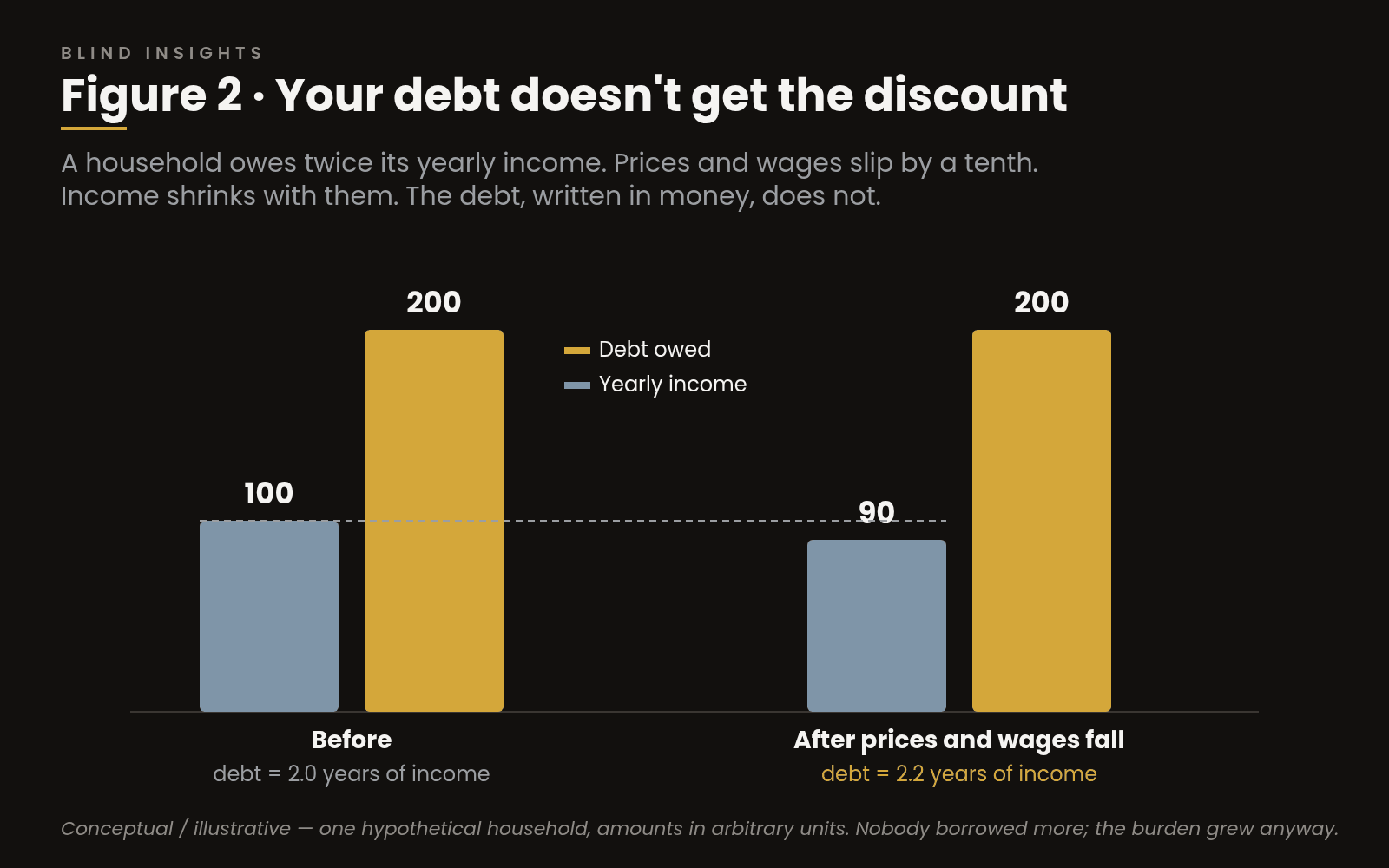
The second problem is quieter and, for many households, more painful. Debts are written in fixed amounts of money. A mortgage, a car loan, a student loan, a company’s bonds — the amount owed doesn’t fall when prices fall. But the income you repay it from does.
Picture a household whose debt is twice its yearly income. Now let prices and wages slip by a tenth. The debt hasn’t changed by a single unit of currency, but income has, so the debt now weighs more than twice as much as a year’s pay. Nobody borrowed more. The burden grew on its own, simply because the money it is measured in became more valuable.
The economist Irving Fisher described this trap in 1933, in the middle of the Great Depression, and called it debt deflation. Borrowers struggling with heavier debts cut spending and sell what they can to pay them down. That selling pushes prices lower still, which makes the remaining debts heavier again. It is the exact reverse of the effect described in The Quiet Tax, where inflation slowly shrinks what borrowers owe. In a deflation the transfer runs the other way: from borrowers to lenders, and it can run fast enough to break the borrowers.
Wages that won’t bend
If every price, wage and debt fell by the same amount at the same moment, deflation would be almost harmless — just a change of units. The trouble is that they don’t move together.
Wages, in particular, are stubborn on the way down. People resist pay cuts fiercely, contracts fix pay for a year or more, and employers know that cutting wages damages morale. So when a firm’s prices and revenues fall, its wage bill often doesn’t — at least not by the same amount. Squeezed between falling revenue and fixed costs, the business has two ways out: reduce how many people it pays, or stop investing. Both feed back into weaker demand.
This is why economists often say deflation turns up as unemployment rather than as cheaper living. The worker who keeps a job at an unchanged wage does gain from falling prices. The worker who loses the job does not, and the fear of being next makes everyone more careful with money.
Why central banks fight it so hard
Normally, when an economy weakens, a central bank cuts interest rates to make borrowing cheaper and saving less attractive. Deflation blunts that tool. Interest rates can’t fall much below zero, because people could simply hold cash instead. But what matters for borrowing decisions is the interest rate after the change in prices — the real rate, explained in how interest rates actually work. If prices are falling, even a zero rate means the money you repay buys more than the money you borrowed. Borrowing becomes expensive in real terms just when the economy needs encouragement.
That is a big part of why both the US Federal Reserve and the European Central Bank aim for inflation of 2 per cent over time rather than zero. A small, steady rise leaves room to cut rates in a downturn and keeps the economy a safe distance from the edge. The ECB says it plainly: it treats undershooting its target as just as undesirable as overshooting it.
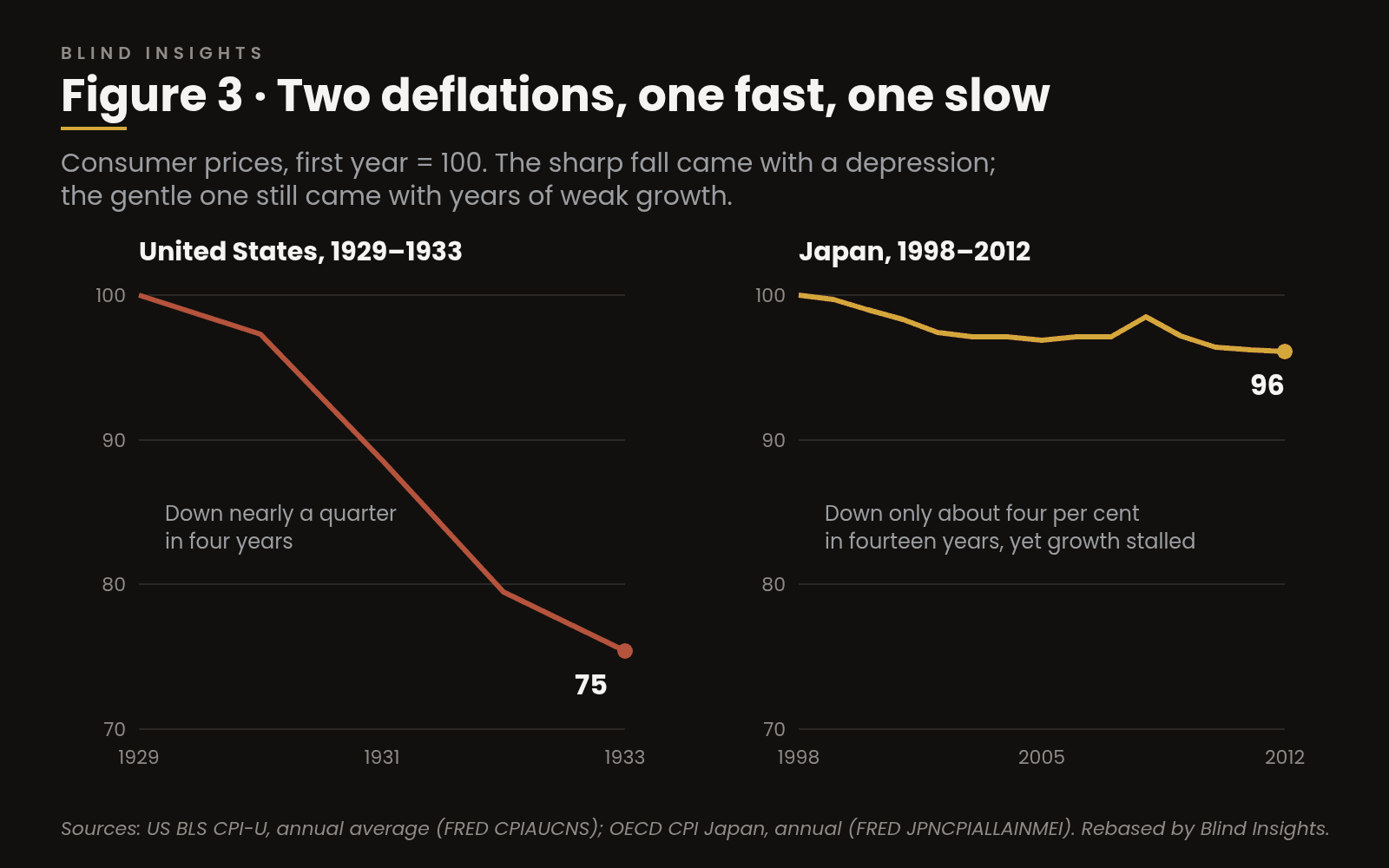
History shows two faces of the problem. In the United States, consumer prices fell by nearly a quarter between 1929 and 1933, alongside bank failures, collapsing output and mass unemployment — the deep version. Japan shows the slow version: from 1998 to 2012 its consumer prices drifted down by only about four per cent in total, yet the period became known for weak growth, hesitant spending and a central bank that struggled to get any traction.
What this is not
This is not a claim that every fall in prices is bad. Cheaper technology, more efficient production and fiercer competition all lower particular prices, and those are among the best things an economy does. It is not an argument that high inflation is fine either — rapid price rises do their own serious damage, especially to people on fixed incomes and to savers. It is not a forecast that deflation is coming, and it is not advice on what to do with your money. It is one clear idea: that a general, lasting fall in prices hits wages, jobs and debts, not just shop prices, and that this is why the institutions that manage money would rather keep prices rising slowly than let them fall.
The question to keep
So the next time you hear someone wish that prices would just go back down — or hear a headline warn about deflation — look past the price tags and ask the question that decides whether it’s good news:
Are a few things getting cheaper because they became easier to make, or is the whole economy getting cheaper because people have stopped spending? The first lifts your living standard. The second tends to arrive with lower pay, fewer jobs and debts that feel heavier every month.
We are not here to tell you what prices should do. We are here to make sure that when falling prices are offered as the obvious cure for an expensive world, you can see the whole machine behind them — including the parts that a lower price tag never shows.
Blind Insights — clarity on money, the economy, and power. We look beneath the surface, because that is usually where the answer is. More at blindinsights.de