Groceries, rent, a coffee, a car, insurance — it all costs more than it used to, and somehow it costs more even when your pay went up. That nagging sense that you’re running to stand still is not in your head. There is a simple mechanism underneath it, and once you see it, the whole thing stops being mysterious.
Almost everyone has had the same quiet, slightly disorienting thought at the supermarket checkout or when the rent renewal lands: wasn’t this cheaper not long ago? You’re earning more than you did a few years back, the economy is described as “growing,” and yet the money seems to melt faster than it used to. It is one of the most searched questions in the world for a reason — it is universal, it is frustrating, and the usual explanations (“inflation,” says the newsreader, and moves on) explain almost nothing.
So let’s actually explain it. Not with jargon, but with the one idea that makes everything else fall into place.
Your money didn’t shrink — it just buys less
Here is the mechanism in a single sentence: prices going up and your money being worth less are not two things. They are the same thing, seen from two directions.
When we say a loaf of bread “costs more,” we picture the bread changing. But the bread didn’t change — it’s the same bread. What changed is the money. Each dollar, each euro, now carries less purchasing power than it did before, so it takes more of them to buy the same loaf. “Prices went up” and “money is worth less” describe one event. This is the heart of it, and it is why the feeling is so slippery: nothing visibly happened to your money. The number in your bank account is the same or higher. But the ground underneath that number moved.
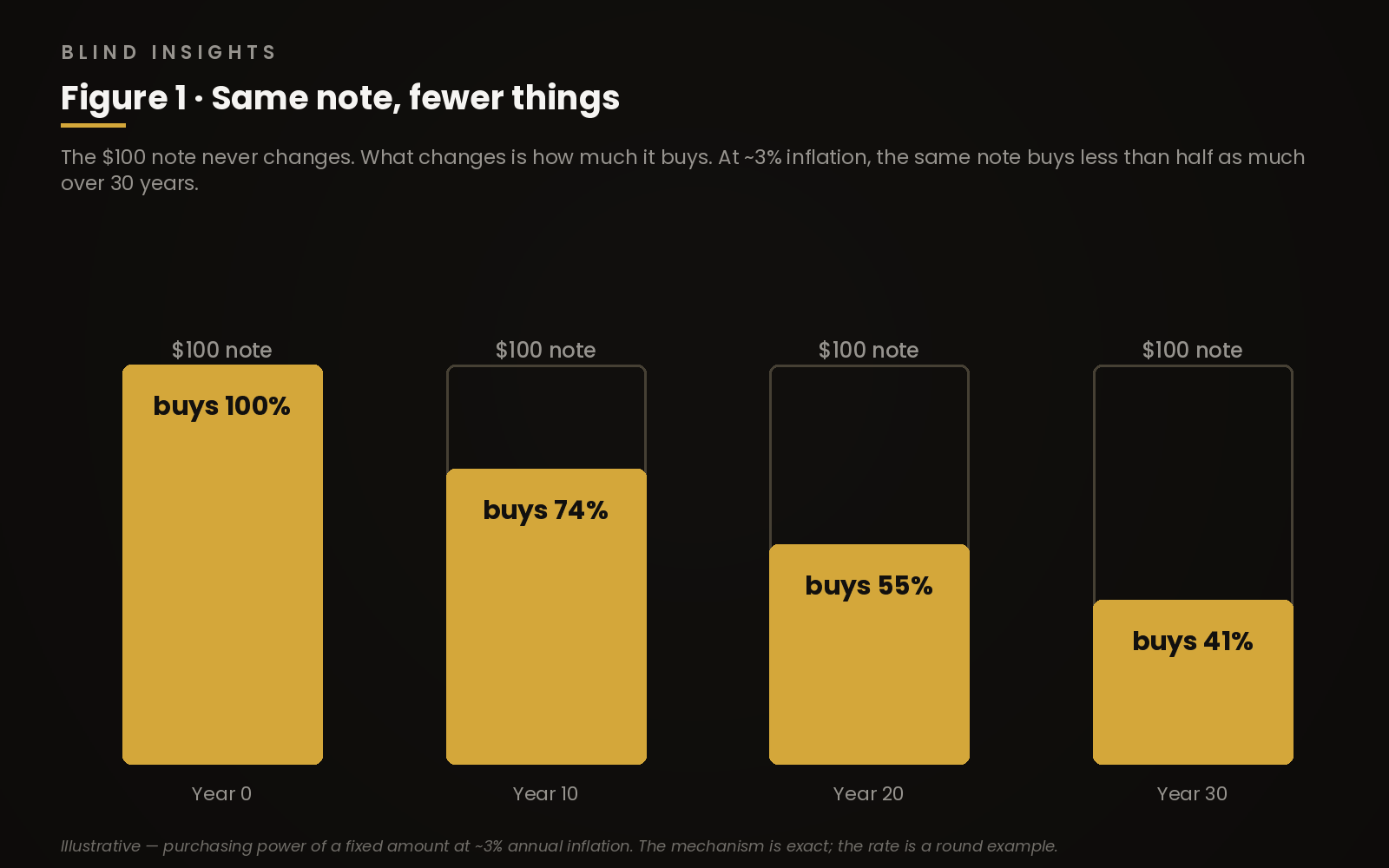
Picture a hundred-dollar note that never changes. The paper is identical year after year. What shrinks is the pile of goods that note can be exchanged for. At a modest, almost boring rate of price increases — say three percent a year — that same note buys noticeably less each year, and over a working lifetime it quietly loses more than half of what it could once buy. The note didn’t move. The world around it did.
Why you feel it even though you earn more
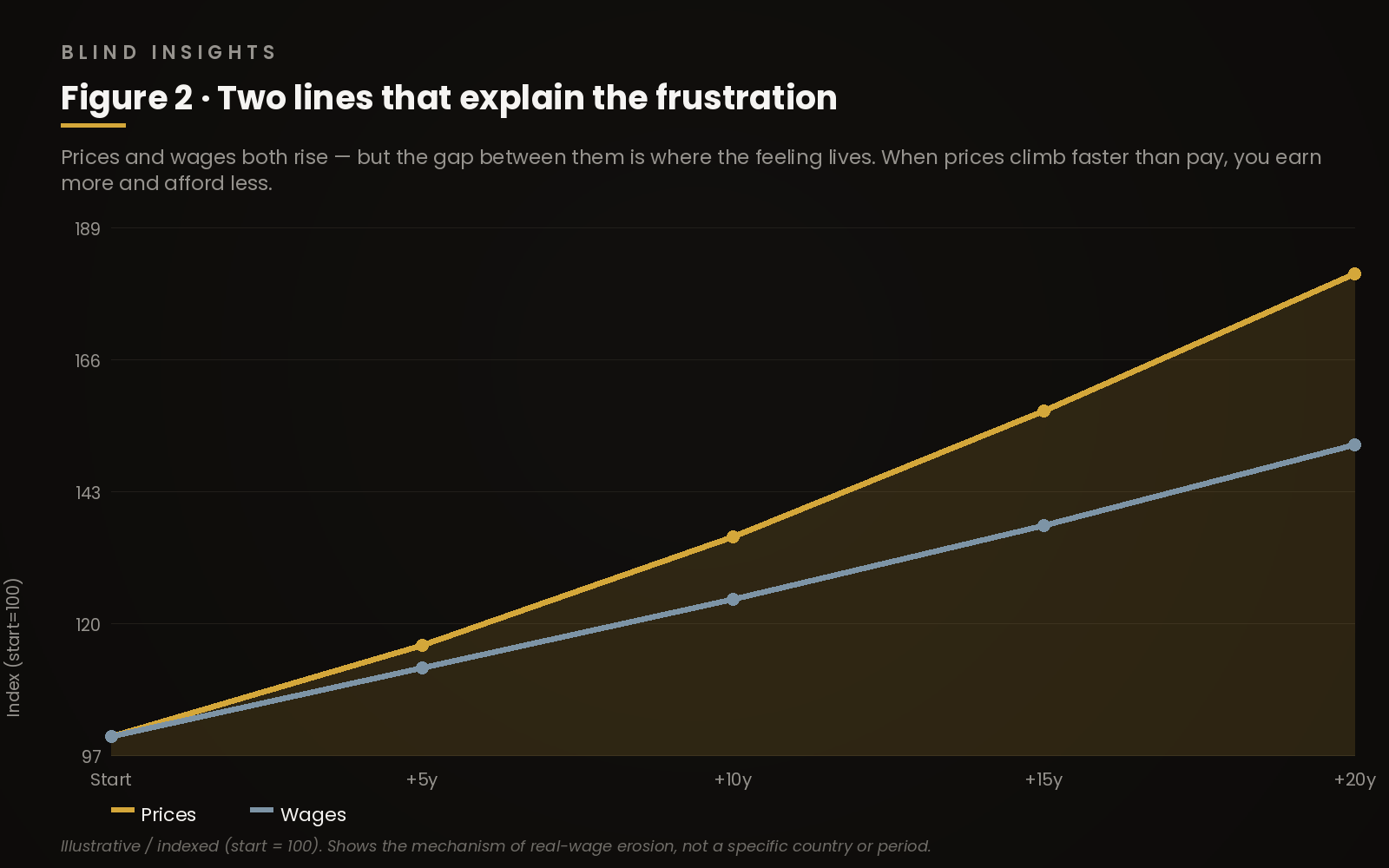
This is the part that makes people feel slightly crazy, so it’s worth being precise. Both of these can be true at the same time: your wages went up and you can afford less. There is no contradiction, and here is why.
Wages and prices both rise over time — but not always at the same speed. What actually determines whether you’re getting ahead or falling behind is not your pay by itself, and not prices by themselves, but the gap between them. If your pay rises 3% while the cost of living rises 5%, your paycheck is bigger and your life is tighter. Economists call your pay measured against prices your real wage, and it’s the only version that tells the truth about how you’re doing. The number on your payslip is the illusion; what it buys is the reality.
That gap is the entire frustration, compressed into one idea. When prices outrun pay — even for a few years — millions of people experience exactly what you’re feeling: working harder, earning more on paper, and watching it buy less at the till.
Why the official number always feels too low
There’s a second, sharper reason the squeeze feels worse than the headlines admit — and it’s not that the numbers are faked.
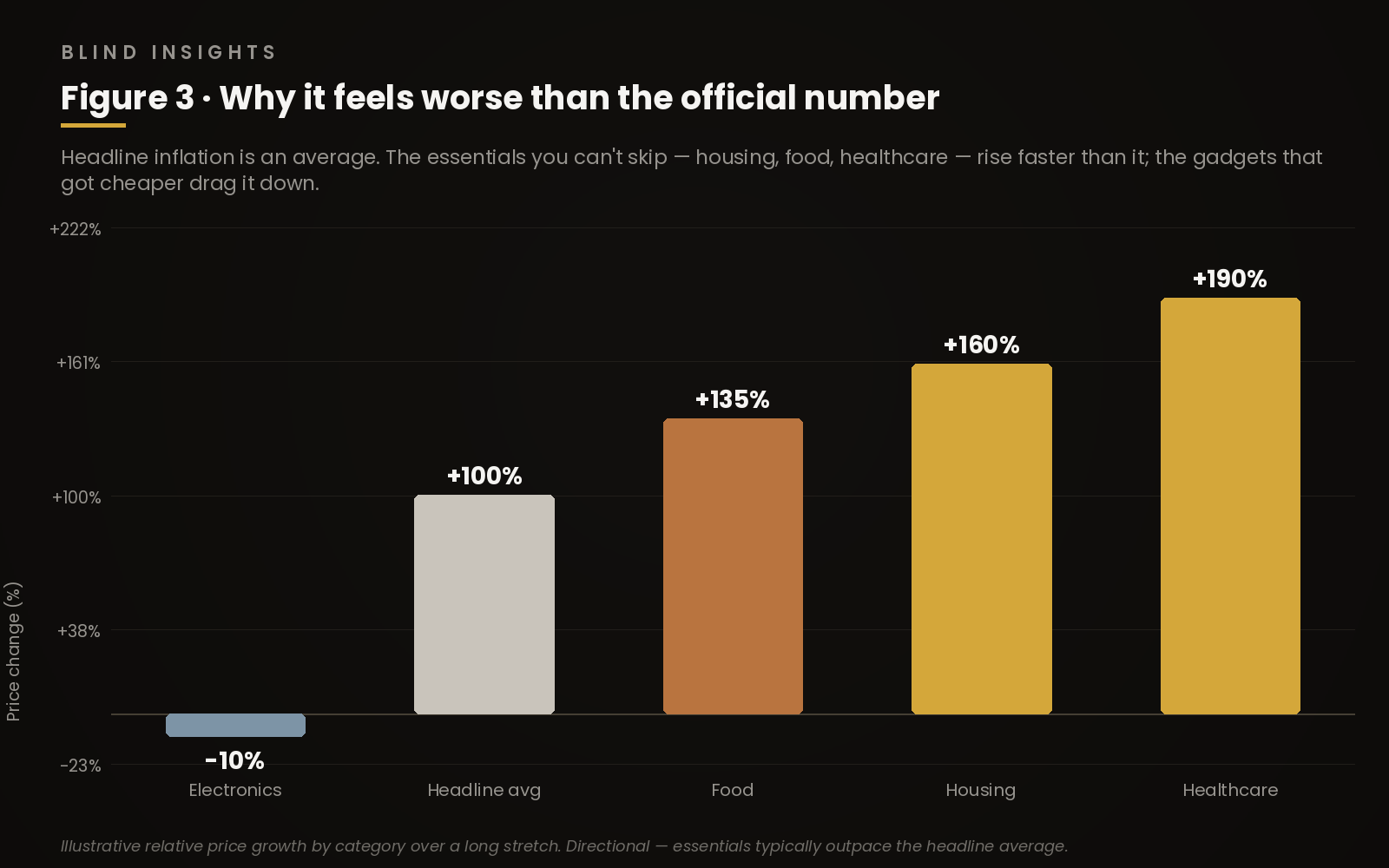
The official inflation figure is an average across a vast basket of everything people buy, including things that barely rose or even fell. Televisions, computers, gadgets — technology tends to get cheaper and better over time, and those falling prices drag the average down. But you don’t buy a new television every week. What you buy constantly, and cannot opt out of, are the essentials: housing, food, energy, insurance, healthcare. And those — the unavoidable ones — have tended to rise faster than the average.
So the headline number can be technically correct and still feel wrong, because the average is held down by cheaper gadgets you rarely buy, while the things you must buy every month are climbing faster than the average suggests. Your personal inflation rate — weighted toward rent and groceries, not toward discounted electronics — is often quietly higher than the one on the news.
A slow, steady leak — not a sudden theft
One more piece, because it explains why this is so hard to notice while it’s happening. A big, sudden price jump gets attention — everyone talks about it. But most of the erosion of your money’s value happens the opposite way: slowly, in small annual steps that are individually easy to shrug off and collectively enormous.
Three percent a year sounds like nothing. But it compounds, quietly, in the background, the same way interest compounds — just working against you instead of for you. A little each year, every year, and the effect over a decade or two is a currency that buys a fraction of what it used to. This is why people who “did nothing wrong” — worked hard, saved cautiously in cash, never gambled — can still feel poorer over time. Holding money that slowly loses value is not a neutral act. It is a slow leak you were never asked to approve.
What this is not
This is not a claim that inflation is a conspiracy, or that the official statistics are fabricated — they are measuring something real, just an average that may not match your basket. It is not a prediction about where prices go next, and it is not advice to buy or do any particular thing with your money. It is one idea, offered plainly: that “everything is expensive” is really “money buys less,” that your pay only matters measured against prices, and that the slow version of this is the one that does the most damage precisely because it’s easy to ignore.
The question to keep
So the next time the checkout total makes you flinch, or a raise somehow leaves you no better off, don’t just file it under “everything’s expensive.” Ask the sharper question underneath it:
Is my pay actually rising faster than the cost of the things I can’t avoid buying — or slower? Because that single comparison, not the number on your payslip and not the headline on the news, is the one that decides whether you’re really getting ahead.
We are not here to tell you what to buy or how to invest. We are here to make sure that when your money seems to melt, you can see exactly what’s melting it — so the feeling stops being a mystery and starts being something you can actually reason about.
Blind Insights — clarity on money, the economy, and power. We look beneath the surface, because that is usually where the answer is. More at blindinsights.de