“How do interest rates work?” sounds like a question with a one-line answer: the central bank sets them. That answer is about one rate out of thousands, and the rest of the picture is far more useful. Over the past two years, the Federal Reserve cut its rate again and again, while the rate on a typical American mortgage ended up higher than when the cutting began. Once you see why, you will read every rate headline differently.
Interest is everywhere in ordinary life, and it is almost never explained. It sits on your savings account, your credit card, your car loan, your mortgage, your pension fund’s bonds and your government’s debt. The news talks about “rates” as if there were one of them, moved up and down by a committee. There isn’t one. There is a whole family of rates, related to each other, but each priced for its own reasons. So let’s start with what a rate actually is.
Interest is the price of time
When you borrow money, you get to use something now that you would otherwise have to wait for. When you lend money, you give that up: the money is gone from your hands until it comes back. Interest is the price of that swap. It is, quite literally, rent on money.
That rent has to cover three things for the lender. First, waiting: money you can’t use for a year is worth less to you than money in your pocket today. Second, inflation: if prices rise while your money is away, what comes back buys less, so the lender wants enough extra to protect their purchasing power. Third, risk: some borrowers don’t pay back, and the lender wants to be paid for taking that chance.
That second point hides one of the most important ideas in money. The rate you see is the nominal rate. What actually matters is the real rate: the nominal rate minus inflation. A savings account paying more than inflation is making you richer in what your money can buy. One paying less is quietly making you poorer, even while the balance goes up. We explored that trap in the money illusion, and it is worth keeping in mind for everything below.
Why every rate is different
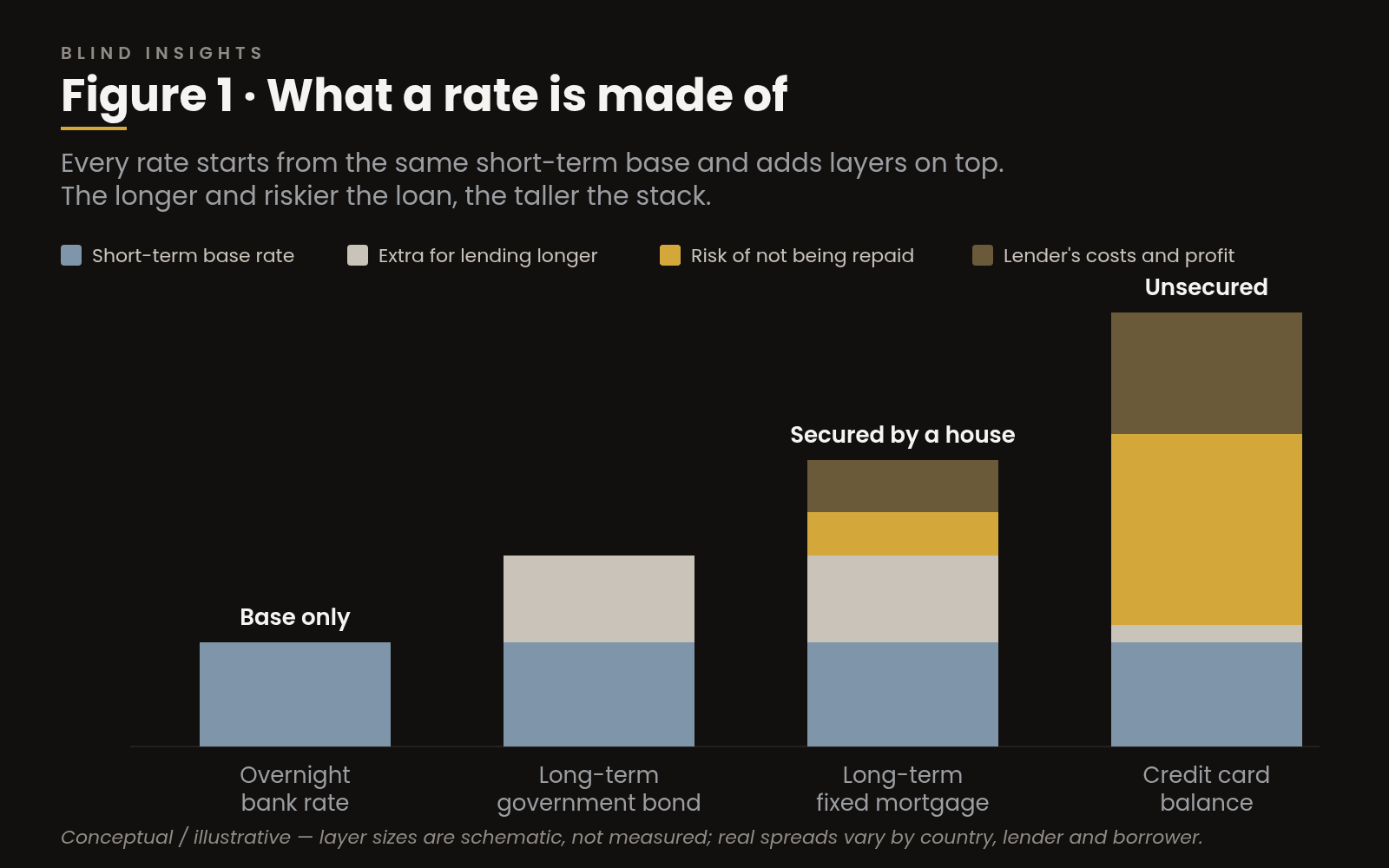
If interest is rent on money, why is the rent on a credit card so much higher than on a mortgage, and both higher than what a government pays? Because each rate is built in layers on top of a common base.
The base is the short-term rate set by the central bank, the rate at which money can be borrowed for a single day by the safest institutions in the system. Every other rate starts there and adds something. Lending for ten years instead of one day adds a layer, because the lender locks money away for longer and has more time for inflation and surprises to bite. Lending to a household or a company instead of a government adds a layer for the risk of not being paid. And every lender adds its own costs and profit on top.
A mortgage is long, but it is secured by a house, so the risk layer is fairly thin. A credit card is short, but it is unsecured, many balances go unpaid, and the lender has to run the whole machine of cards and payments, so the risk and cost layers are thick. That is why the same household can borrow at very different prices on the same day.
What the central bank actually controls
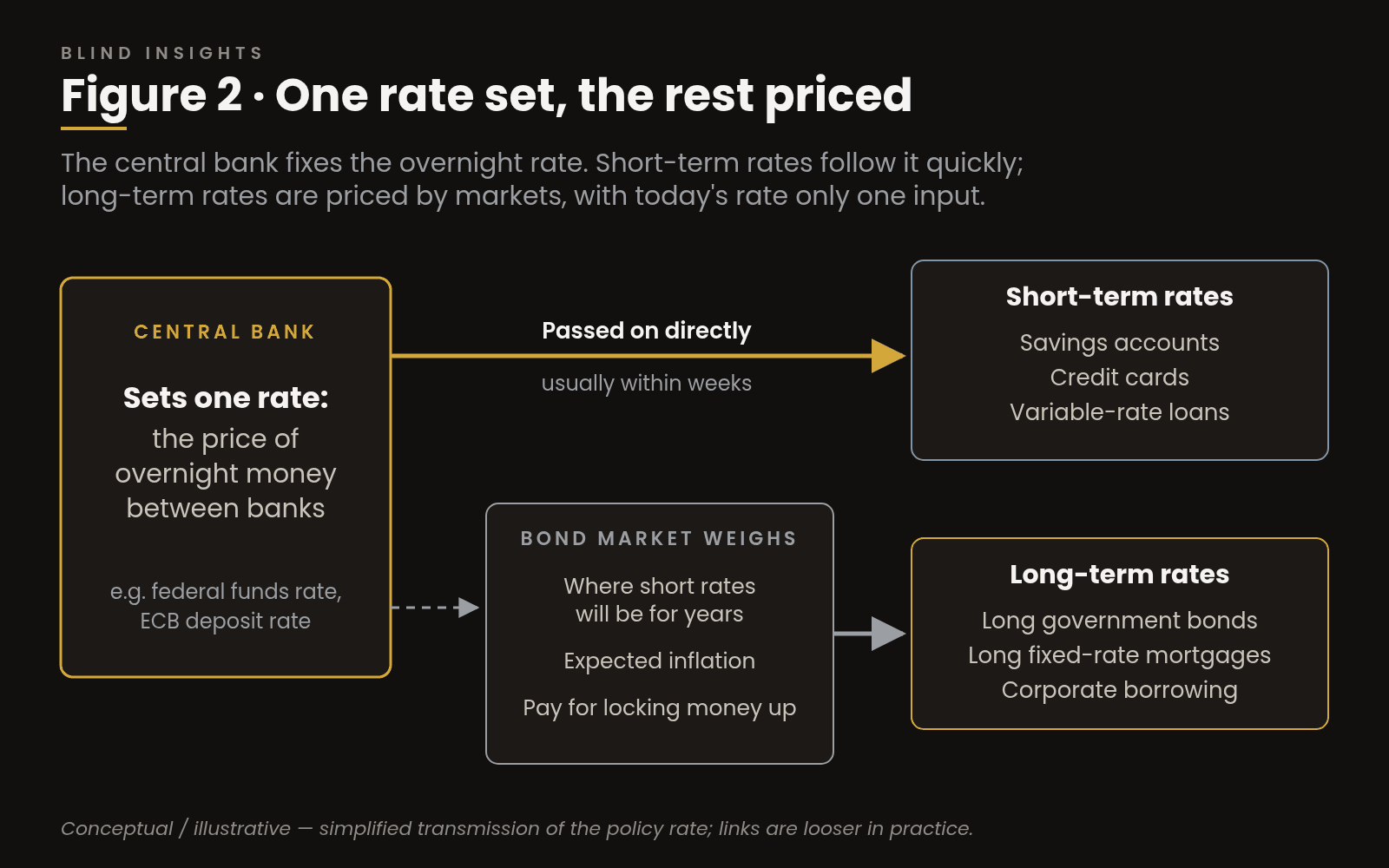
Now the committee. A central bank such as the Federal Reserve or the European Central Bank sets one thing directly: the price of overnight money between banks. In the United States that is the federal funds rate. The central bank steers it through the interest it pays banks on the money they keep with it, and through how much of that money it supplies.
That one rate travels fast through anything short-term. Savings accounts, credit cards, variable-rate loans and business credit lines are tied, directly or loosely, to short-term rates, so when the central bank moves, they usually follow within weeks.
Long-term rates are different. Nobody sets the rate on a ten-year government bond or a thirty-year fixed mortgage. They are priced every day in the bond market, by millions of buyers and sellers weighing three questions. Where will short-term rates be over the next decade, not just this month? What will inflation do over that time? And how much extra do I want for locking my money up for so long? Today’s central bank rate feeds into the first question. It does not answer the other two.
Why a rate cut can still raise your mortgage
This is where the distinction stops being academic. In August 2024, the federal funds rate averaged 5.33 percent. The Federal Reserve began cutting the following month, and by August 2026 it averaged 3.63 percent, 1.70 percentage points lower. If the central bank “set interest rates”, mortgages should have become much cheaper.
They didn’t. Over the same two years, the yield on the 10-year US Treasury bond rose from 3.87 percent to 4.68 percent. The average 30-year fixed mortgage rate, which tracks long-term bond yields far more than it tracks the Fed, went from 6.50 percent to 6.67 percent. By the last week of October 2026, it stood at 7.24 percent.
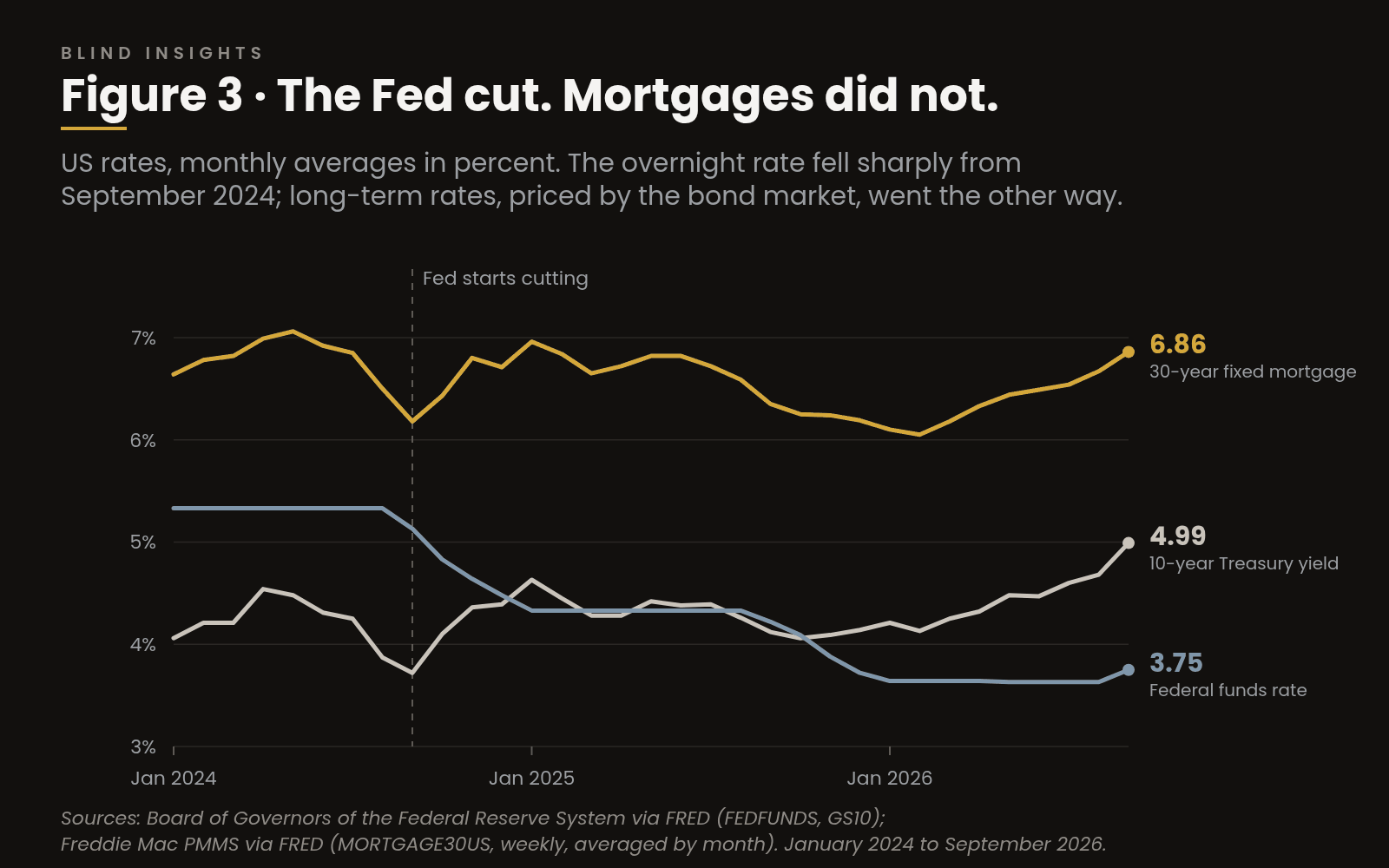
Nothing here is a contradiction. The people who price long-term bonds were answering their own three questions. If they expect inflation to stay stubborn, if they expect governments to keep borrowing heavily, or if they simply want more reward for tying up money for a decade, they demand a higher yield, whatever the overnight rate is doing. A cut can even push long rates up, if markets read it as a sign that the central bank will tolerate more inflation later. The central bank holds the short end of the rope. The market holds the long end.
Why rates touch everything you own
Interest rates matter far beyond the loans you take out, because they are the yardstick every other price is measured against.
When safe rates are high, cash and bonds pay a decent return for doing nothing, so other investments have to offer more to compete. That pulls down what people will pay for shares, houses and businesses today for a given stream of future income. When safe rates are low, the opposite happens: money goes looking for return elsewhere, and asset prices tend to rise. The same logic explains why an existing bond’s price falls when rates rise, which we walked through in what a bond really is.
Rates also shape behaviour. Higher rates reward saving and make borrowing costlier, so households and companies spend and invest less. That is precisely why central banks raise them to cool inflation, and cut them to support a weak economy. And over long periods, the gap between the rate you pay and the rate you earn compounds into very large sums, in either direction, as we showed in compound interest, in both directions.
What this is not
This is not a forecast of where interest rates go next, and it is not a claim that central banks are powerless; the overnight rate is a strong lever, it simply isn’t the only one. It is not advice on whether to fix or float a mortgage, pay down debt or hold cash, which depends entirely on your own circumstances. It is one organising idea: that an interest rate is a price built in layers, that a central bank directly sets only the shortest of them, and that the long-term rates which matter most for big decisions are set by markets weighing time, inflation and risk.
The question to keep
So the next time you read that “the central bank cut rates”, don’t stop at the headline. Ask the two questions that tell you what it actually means for you:
Which rate in my own life is short-term, and will follow this move within weeks, and which is long-term, priced by markets that may be thinking about something else entirely? And after inflation, is the rate I earn on my savings above zero or below it?
We are not here to tell you what rates will do. We are here to make sure that when they move, you know which ones moved, who moved them, and why the one on the news may not be the one on your bill.
Blind Insights — clarity on money, the economy, and power. We look beneath the surface, because that is usually where the answer is. More at blindinsights.de