US federal debt just crossed $40 trillion, and the interest on it is now the second-largest item in the entire federal budget. When a government owes that much, it has options most people never think about — including one that quietly transfers wealth from savers to the state without a single vote being cast. This is a read of that mechanism, not a set of recommendations.
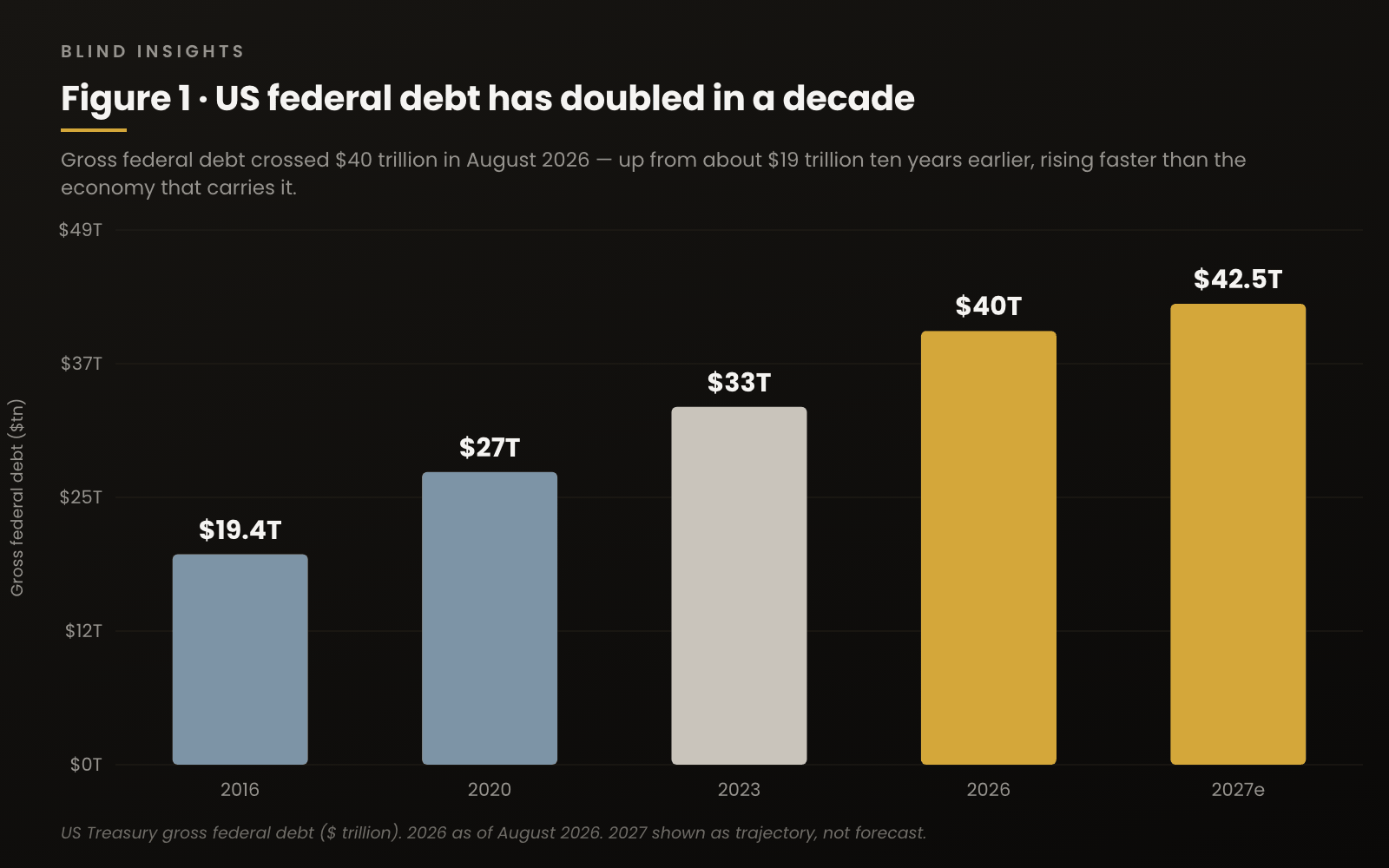
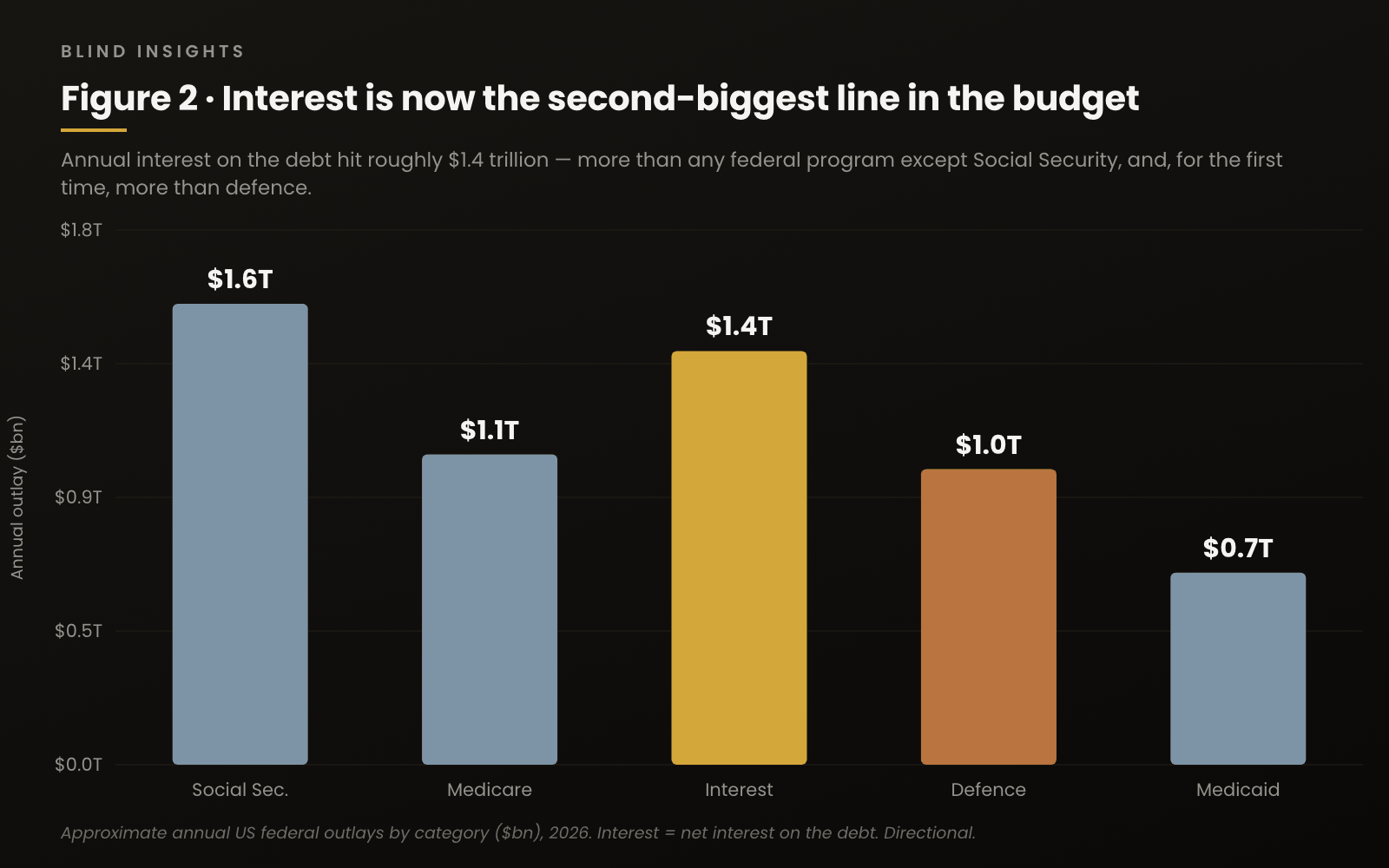
In August 2026, US federal debt passed forty trillion dollars — double what it was a decade earlier. In the same stretch, the annual interest bill on that debt climbed toward one and a half trillion dollars, overtaking the entire defence budget and becoming the second-biggest line in the federal budget, behind only Social Security. A government can, in principle, deal with a debt like this in a few ways. It can grow out of it, which is slow and not guaranteed. It can cut spending or raise taxes, both of which are politically excruciating and, so far, not happening. Or it can use a quieter method — one with a name most people have never heard, even though they may be paying it right now.
That method is called financial repression, and understanding it explains a great deal about the world of low-for-long interest rates, stubborn inflation, and why the “safe” part of your savings has quietly gone nowhere for years.
The oldest trick: let inflation do the work
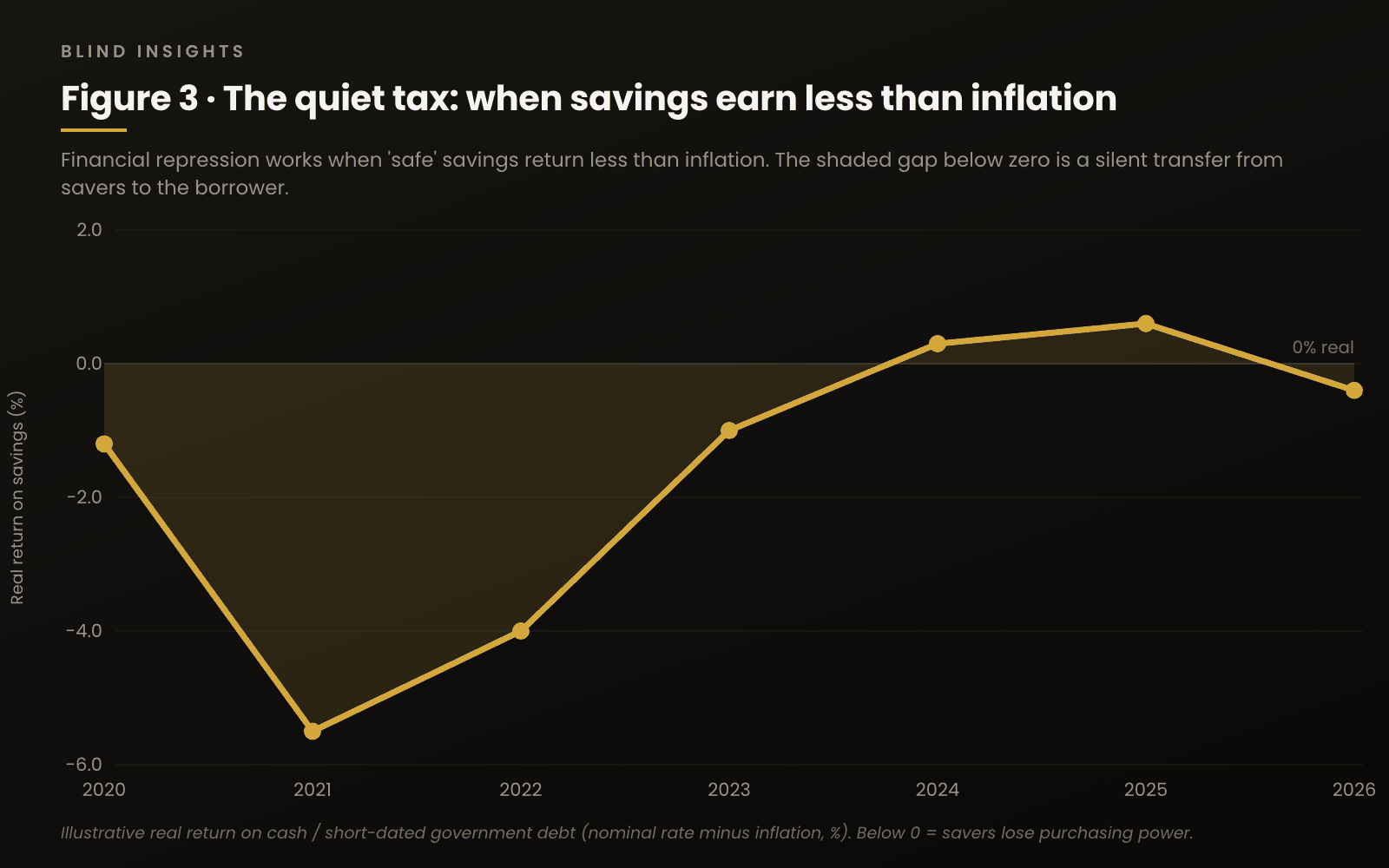
Strip financial repression down to its engine and it is almost embarrassingly simple: keep the interest rate that savers earn below the rate of inflation, and hold it there. That’s it. Everything else is machinery built around that one idea.
Here is why it works. A government’s debt is fixed in nominal terms — forty trillion is forty trillion. But what that forty trillion is worth, in real purchasing power, erodes with inflation. If prices rise faster than the interest the government pays on its debt, the real value of the debt shrinks every year, quietly, on its own. The debt doesn’t have to be paid down; it is inflated away — melted, slowly, by the gap between inflation and the interest rate.
And the flip side of that same coin is the part that matters to you. The gap that shrinks the government’s debt is paid by whoever holds that debt at a below-inflation return: savers in bank accounts, holders of government bonds, pension funds, insurers. Their money grows too slowly to keep up with prices, so it loses purchasing power year after year. That lost purchasing power doesn’t vanish — it is transferred to the borrower, the government, whose burden lightens by exactly the amount the saver’s does. It is, in every meaningful sense, a tax — just one that never appears on a tax form, was never legislated, and that most of the people paying it will never identify.
Why now: the arithmetic of $40 trillion
This is not a historical curiosity. It is exactly the situation the numbers are backing the United States into. With interest already the second-largest item in the budget, every extra percentage point on the government’s borrowing cost translates into hundreds of billions more in interest — which means more borrowing, which means more debt, which means more interest. Left unchecked, that is a self-reinforcing spiral.
There are only two ways to relieve it: bring the debt down (politically almost impossible right now) or keep the cost of the debt suppressed below the rate at which the economy grows and prices rise. The second is financial repression, and it is the path of least political resistance — because its cost is invisible, spread thinly across every saver, and paid slowly rather than all at once. No politician has to cast a vote to raise a tax. The bill simply arrives, quietly, in the form of savings that don’t keep up.
The plumbing: keeping the debt machine running
Financial repression used to be crude — in earlier eras, governments simply capped interest rates by law and forced banks to hold their bonds. The modern version is subtler, and it is happening in a corner of the financial system almost no ordinary investor watches: the market that funds the government’s borrowing.
The mechanism runs like this. The old, patient buyers of US government debt — foreign central banks, in particular — have been stepping back. Into the gap have stepped highly leveraged funds that buy government bonds not with their own money but with borrowed money, financed through a short-term lending market where the same bond can be pledged again and again to fund the next purchase. It is an enormously efficient machine for absorbing a flood of new government debt without requiring a flood of new real savings to exist. It is also fragile: it runs on cheap, continuous, short-term funding, and it seizes up violently when that funding gets expensive or when lenders suddenly demand more collateral.
That fragility is the tell. It explains why, over the past year, the government’s financial managers have quietly pushed a whole series of seemingly unrelated measures — adjusting bank regulations so big institutions can hold more of this debt, buying back hard-to-trade bonds, managing cash reserves to keep short-term funding rates calm, even coordinating a currency intervention that reduced the risk of a foreign holder being forced to dump its US bonds. Read one at a time, they look technical and disconnected. Read together, they point one direction: keeping the machine that finances the debt running smoothly and cheaply. The modern state doesn’t just manage its debt; it manages the plumbing that makes the debt bearable.
Why this quietly touches everything you own
Here is the consequence that reaches beyond bonds. When the overriding priority becomes keeping the cost of debt low and the funding system stable, it shapes the entire environment for money. Interest rates are held down. Liquidity is kept abundant, and topped up whenever the system wobbles. And that abundance has to go somewhere — it flows into assets, lifting stocks, real estate, gold, and scarcer stores of value.
This is why so many people have concluded that holding cash for the long run feels like a losing game, and why hard or scarce assets attract money in a high-debt, repressed-rate world: they are, in part, an attempt to escape the quiet tax. It also carries a warning the enthusiasts skip — the same system that lifts assets in calm times can reverse hard when the funding machine seizes, and in those moments almost everything can fall at once, even the supposed safe havens, because what suddenly matters is not value but liquidity.
What this is not
This is not a prediction of imminent crisis — there is no magic debt number at which a country tips over, and a heavily indebted state can carry on for a very long time. It is not a claim that inflation is secretly engineered; repression is more often a passive drift than a deliberate plot. And it is emphatically not advice to buy gold, sell bonds, pile into anything, or panic — against a slow, systemic force like this, the honest counsel is understanding first, not trading. It is one durable idea: that a heavily indebted government has a quiet incentive to keep your savings earning less than inflation, and that much of what looks like unconnected financial news is that incentive at work.
The question to keep
So the next time you read that debt has hit a new record, or that some obscure funding market needed “support,” or simply that your savings account still pays almost nothing while prices keep rising, connect them and ask the question the headlines rarely do:
Is the real return on my safe savings above inflation, or below it? Because if it is below — quietly, year after year — then the answer to “who pays for the debt?” may already include you, and the payment is being taken not in a lump sum you’d notice, but in a slow leak you were never asked to approve.
We are not here to tell you what to do about it. We are here to make sure that when the largest debt in history is described as somebody else’s problem, you can see the quiet mechanism that spreads a piece of it, invisibly, to everyone who saves.
Blind Insights — clarity on money, the economy, and power. We look beneath the surface, because that is usually where the answer is. More at blindinsights.de