A hundred-dollar bill is a rectangle of paper that costs a few cents to print. Your bank balance is a number in a database. Neither is backed by gold. So why does any of it work — why will a stranger hand you real goods in exchange for it? The answer is stranger, and simpler, than most people ever stop to consider, and once you have it, a great deal of the economy stops being mysterious.
Here is a question almost nobody asks, because it feels too basic to ask: why is money worth anything? Hold a banknote up to the light. It is paper. The number in your banking app is just that — a number, a database entry. There is no vault of gold behind it. And yet you can hand that paper, or move that number, to a complete stranger and walk away with food, fuel, a phone, an hour of someone’s labour. Something is making that work. Understanding what — and what isn’t — is the foundation underneath every other money question there is.
Money isn’t a thing — it’s a job
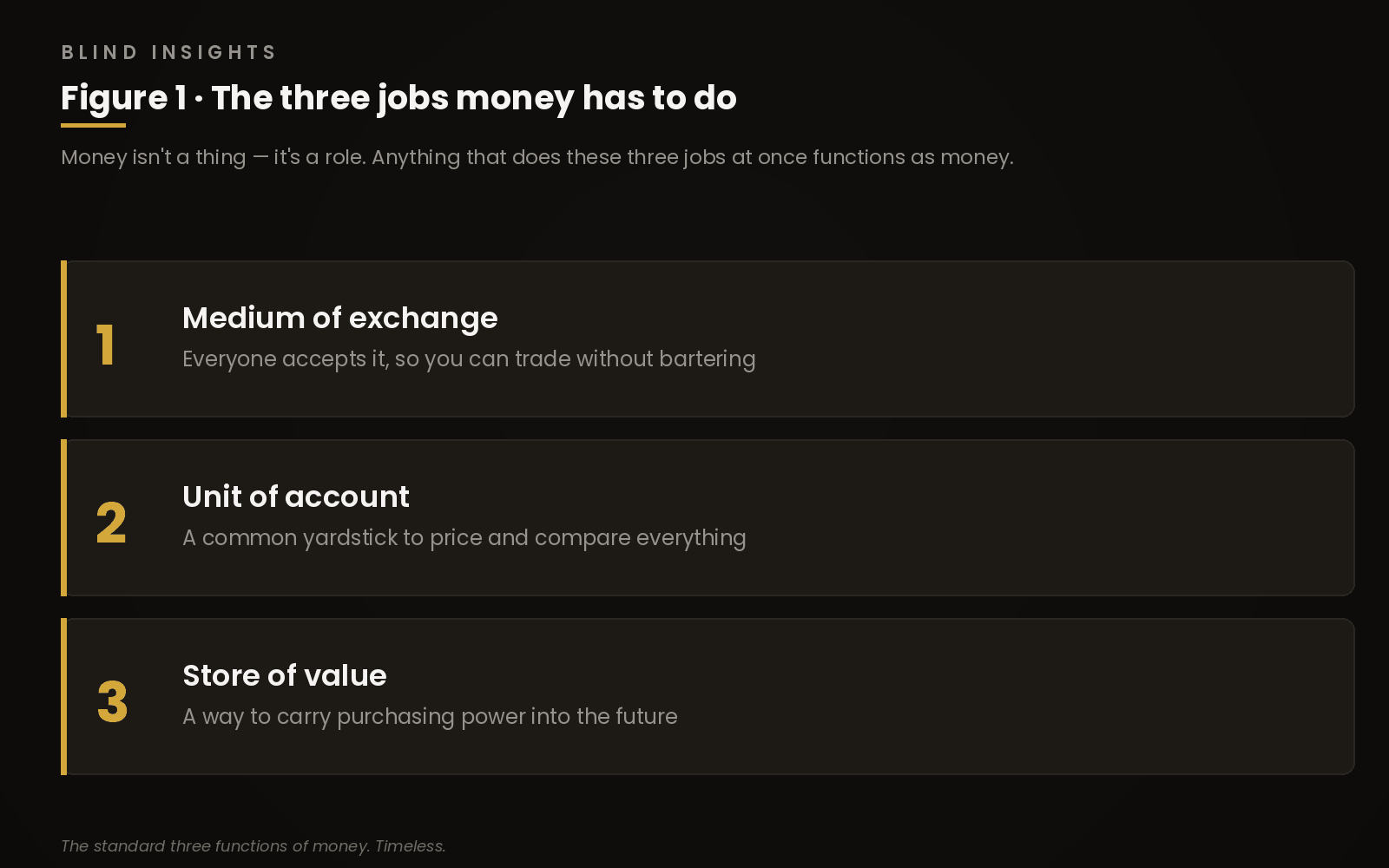
The first step is to stop thinking of money as an object and start thinking of it as a role. “Money” is not a particular substance; it’s anything that successfully does three jobs at the same time.
It has to be a medium of exchange — something everyone will accept, so you can trade without having to barter (without needing to find someone who happens to want your chickens and has the shoes you want). It has to be a unit of account — a common yardstick, so you can price a car and a coffee in the same units and compare them. And it has to be a store of value — a way to hold your purchasing power over time, so what you earn today still buys something next month.
Anything that can do all three is money. A cow did it. Salt did it. Gold did it. Cigarettes have done it in prisons. Paper does it now, and so do pure digital entries. Nothing about money requires it to be shiny, physical, or backed by metal — it only has to do the three jobs.
The long drift away from “real” value
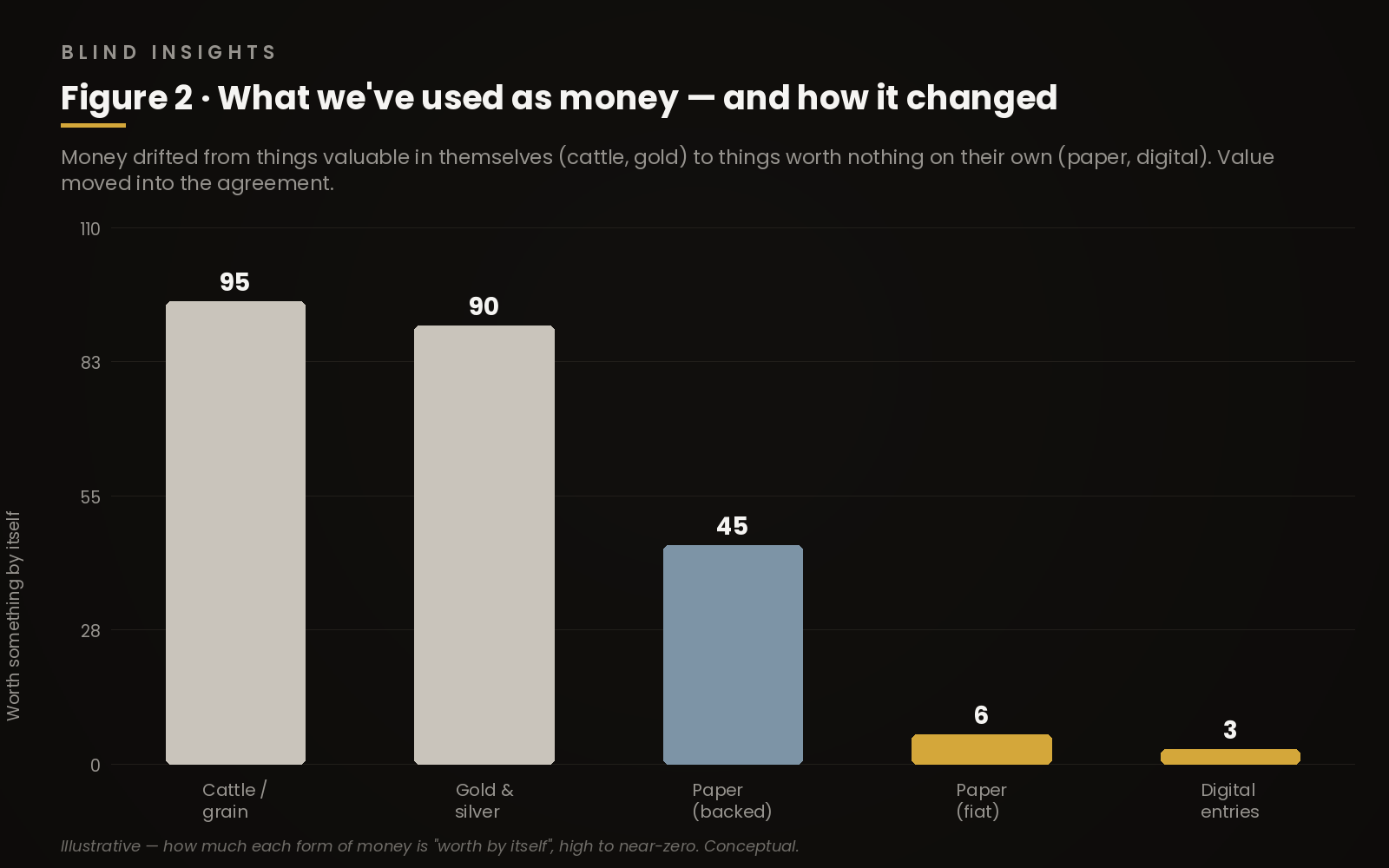
Here’s where it gets interesting, because the history of money is a steady drift in one direction: away from things valuable in themselves, and toward things that are worth nothing on their own.
Early money was often something genuinely useful — cattle, grain, salt. It had value whether or not anyone agreed to use it as money; you could eat it or use it. Then came precious metals: gold and silver were still worth something in themselves (jewellery, status), but their main job became exchange. Then paper money arrived as a claim on gold — a note that promised you could swap it for real metal held in a vault. For a long time, the paper was a stand-in for something solid.
And then, in the twentieth century, the last link to gold was cut. Modern money became fiat — a word that simply means “it is money because the government declares it to be, and because everyone treats it as such.” The paper stopped being a claim on anything. The value didn’t disappear, though. It moved — out of the object itself and into the agreement among everyone using it.
So what actually backs it now?
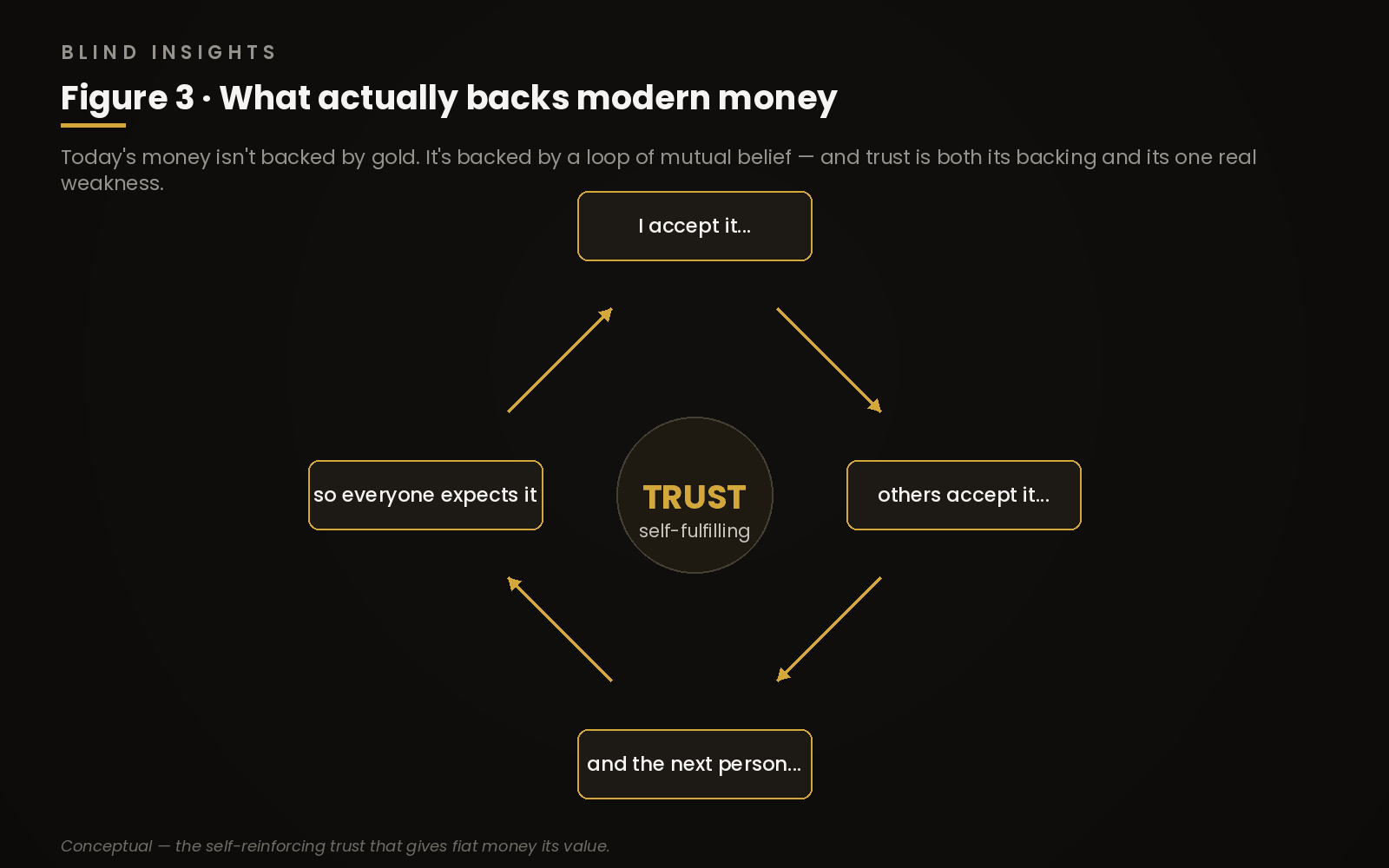
If modern money isn’t backed by gold, or by anything you can dig up, what holds it up? The honest answer is almost uncomfortably simple: trust — and specifically, a self-reinforcing loop of it.
You accept a banknote not because it’s intrinsically valuable, but because you’re confident that someone else will accept it from you tomorrow. And they accept it for exactly the same reason — because they’re confident the next person will. Round and round. Money works because everyone believes everyone else believes in it. It is one of the largest and most successful shared agreements in human history, and it is held together by nothing more solid, and nothing less powerful, than collective confidence.
This isn’t a flaw or a scandal — it’s simply what money is, and the system is remarkably robust precisely because the belief is so widely shared. But it does reveal where the one real vulnerability lies. Money isn’t threatened by running out of gold. It’s threatened by anything that erodes the trust: a government printing so much of it that people start to doubt it will hold its value, or a collapse of confidence in the institutions that issue and manage it. When people stop believing, the paper goes back to being paper — which is exactly what you see in a hyperinflation, where a currency dies not because the paper changed, but because the belief did.
Why this is the key that unlocks everything else
Once you see that money is a shared belief rather than a physical thing, a whole set of otherwise-confusing ideas suddenly make sense. Why can a central bank “create” money seemingly from nothing? Because money was never a fixed pile of stuff — it’s an entry that can be added to, as long as trust holds. Why does printing too much of it cause inflation? Because spreading the same total trust across more units makes each unit worth less. Why do people flee to gold or other scarce assets when they’re nervous? Because those can’t be printed, so they feel like an escape from a system built on belief. Every one of those questions has the same root, and you now hold it.
What this is not
This is not a claim that money is “fake” or worthless — it is intensely real in its effects, and the trust behind it is genuine and durable, not a trick. It is not an argument that we should return to gold, or abandon fiat, or adopt any particular alternative; that’s a separate debate with serious points on every side. And it is not financial advice of any kind. It is one foundational idea: that money is a role filled by trust, not a substance backed by metal — and that this is a feature of how it works, not a dirty secret about it.
The question to keep
So the next time you hand over a banknote, move a number between accounts, or hear that a central bank has “created” more money, pause on the question almost nobody asks:
What is actually making this worth something — and is the trust underneath it being strengthened, or quietly stretched thin? Because the paper and the numbers are never the real story. The agreement behind them is.
We are not here to tell you what money will be worth next year. We are here to make sure that when you use it, you understand what you’re actually holding — not a piece of gold, not a piece of paper, but a share in one of the oldest and most important agreements humans have ever made.
Blind Insights — clarity on money, the economy, and power. We look beneath the surface, because that is usually where the answer is. More at blindinsights.de