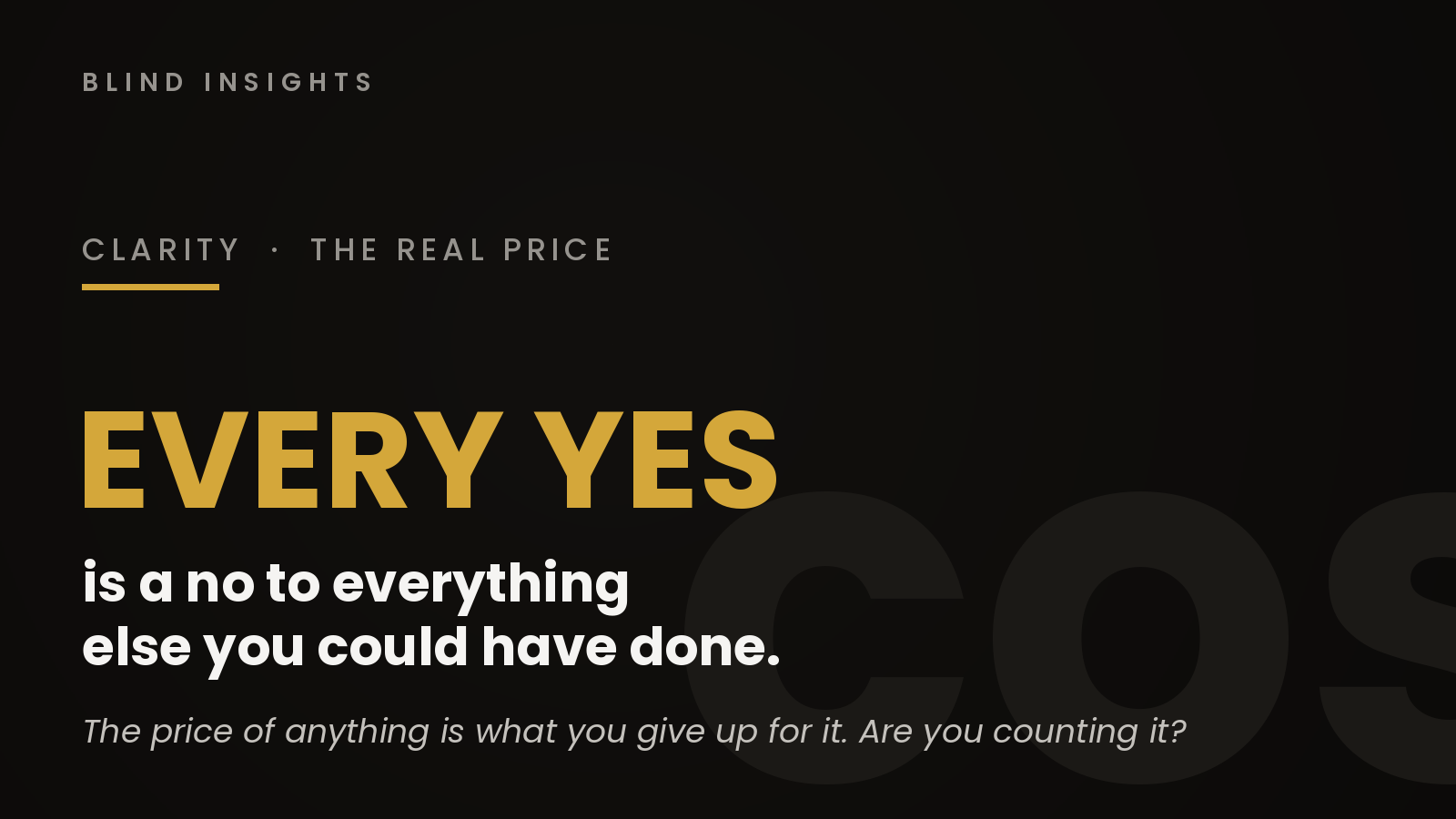
The true cost of a choice is never the money you spend. It is the best alternative you gave up to make it. Most people never calculate this — which is exactly why they make the choices they do.
When you buy something, you think you know what it cost: the price on the tag. But the price tag is only the visible part of the cost, and often the least important part. The real cost of any choice is everything else you could have done with the same money, time or attention — and chose not to. Economists call this opportunity cost, and it is one of those ideas that, once understood, quietly rearranges how you see every decision.
The principle is short: the cost of anything is what you give up to get it. Every yes is also a no — a no to every other thing that same resource could have become.
Why the invisible cost is the real one
The reason opportunity cost is so easy to ignore is that the thing you gave up never happened, so there is nothing to look at. The dollar you spent is visible. The investment that dollar could have grown into, the experience it could have bought, the debt it could have repaid — those are invisible, because you chose otherwise and they never came to exist.
Consider money sitting idle in a low-interest account. Nothing appears to be lost; the balance is not shrinking in nominal terms. But that money could have been doing something else — earning a return, paying down a costly debt, funding something that mattered. The cost of leaving it idle is not zero just because no number went down. The cost is the best thing it could have been doing instead, and that cost is being paid every day, silently, in a currency that never appears on any statement.
The same is true of time, which is the resource where opportunity cost bites hardest. An hour spent on one thing is an hour unavailable for everything else, and unlike money, time cannot be earned back. Every commitment is a quiet refusal of all the alternatives.
The trap of “I can afford it”
Opportunity cost exposes a flaw in the most common way people make decisions. We tend to ask: can I afford this? If the answer is yes — if the money is there — we proceed. But “can I afford it” is the wrong question, because it only checks the visible price against your available funds. It never asks what else that money was for.
The better question is comparative: is this the best use of this resource, among the alternatives actually available to me? A purchase you can easily afford can still be a poor choice, if something more valuable was quietly sacrificed to make it. The money was there; that was never the issue. The issue is what it could have become instead, and whether you ever stopped to weigh that.
This reframing is uncomfortable precisely because it never lets a decision off the hook. There is no such thing as a free choice, or a cost-free yes. Even doing nothing has a cost — the value of the action you didn’t take.
Where it changes real decisions
Carried into daily life, opportunity cost sharpens choices that otherwise feel obvious.
A “good deal” is only good if the money wasn’t more valuable elsewhere. A long commute to save on rent costs hours that could have been worth more than the savings. Keeping money safe and idle has a cost measured in the returns or relief it could have provided. Even a generous-sounding offer — a job, a contract, a windfall with strings — has to be measured not against zero, but against what you would otherwise have done with the time and freedom it consumes. In each case, the visible price is the smaller half of the story.
What this is not
This is not an argument that you should agonise over every small purchase, or that spending money on things you value is wrong — sometimes the alternative you give up genuinely is worth less than the thing you choose, and then the choice is correct. Nor is it a claim that everything must be optimised to the last cent; that way lies paralysis. It is one mental tool: a reminder that the price tag is never the whole cost, and that the most important part of the cost is the part you cannot see because you chose against it.
The question to keep
So the next time you are about to commit money, time, or attention to something, do not stop at “can I afford it.” Ask the question opportunity cost forces:
What is the best thing I could do with this exact resource instead — and is the thing I’m choosing actually better than that?
We are not here to tell you how to spend your money or your hours. We are here to make sure you are counting the whole cost — including the part that never shows up, because you said no to it.
Blind Insights — clarity on money, the economy, and power. We look beneath the surface, because that is usually where the answer is. More at blindinsights.de