“Who do we owe the national debt to?” is one of those questions people ask half-joking, as if the answer were a shadowy creditor somewhere abroad, waiting to collect. The real answer is stranger and more useful: most of the debt is owed to people and institutions inside the country, a large slice is owed by the government to itself, and the part that really deserves your attention isn’t who holds it at all.
US federal debt passed 40 trillion dollars in August 2026. A number that size is impossible to picture, and so it tends to be discussed like weather — something vast and ominous that hangs over everyone. The picture most people end up with is of a nation that has maxed out its credit card with a single, impatient lender. Almost every part of that picture is misleading. So let’s take the debt apart, piece by piece, and look at who is actually on the other side of it.
First, debt and deficit are not the same thing
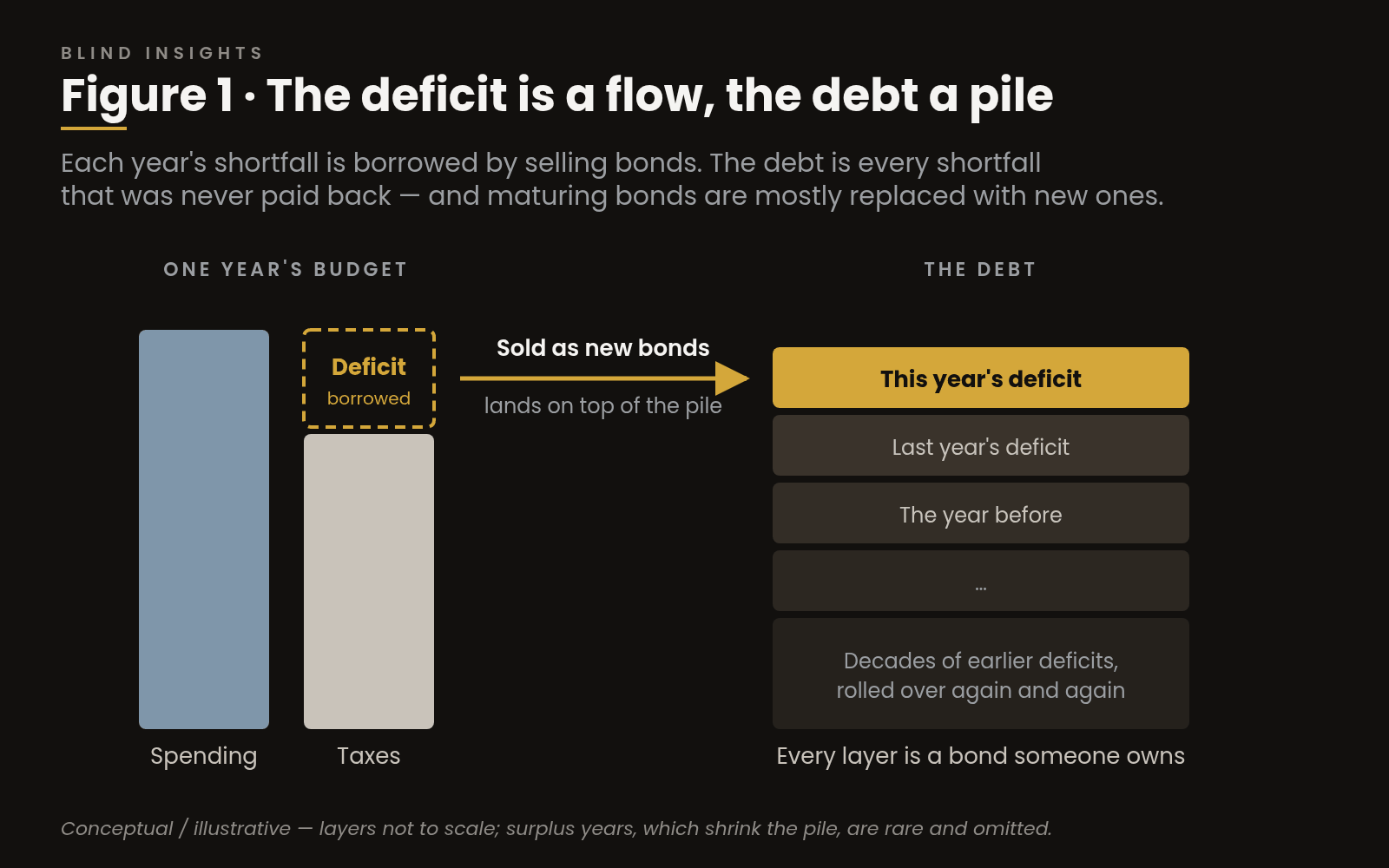
Two words get used interchangeably, and they shouldn’t be. The deficit is a flow: in any given year, the government spends more than it collects in taxes, and the gap is the deficit. The debt is a stock: it’s the pile left behind by all those yearly gaps, added together, minus the rare years when the government took in more than it spent.
How does a government cover that yearly gap? It borrows, and it borrows in a very particular way — by selling bonds. A government bond is simply an IOU: you hand over money today, and the Treasury promises to pay you interest along the way and your money back on a set date. Each year’s deficit becomes a fresh batch of these IOUs, stacked on top of the batches from every year before.
And here’s the part that surprises people: the pile is almost never “paid off” in the way a mortgage is. When an old bond comes due, the government usually pays it back by selling a new one. This constant refinancing is normal for governments — it’s how the debt rolls forward through time. Unlike a person, a government doesn’t retire.
Every IOU has an owner
Once you see the debt as a stack of bonds, the question “who do we owe it to?” answers itself in principle: we owe it to whoever owns the bonds. And that leads to the single most clarifying fact about government debt. One side’s debt is always someone else’s asset. The 40 trillion dollars the government owes is, at the very same moment, 40 trillion dollars of assets sitting on other balance sheets — in the government’s own trust funds, pension funds, bank reserves, insurance portfolios, money market funds and retirement accounts.
That’s not a trick of accounting; it’s what a debt is. (If you want the mechanics of the IOU itself, our piece on what a bond actually is walks through it.) So the useful question isn’t “how big is the monster?” but “whose savings is this, and what happens to them?”
So who actually holds it?
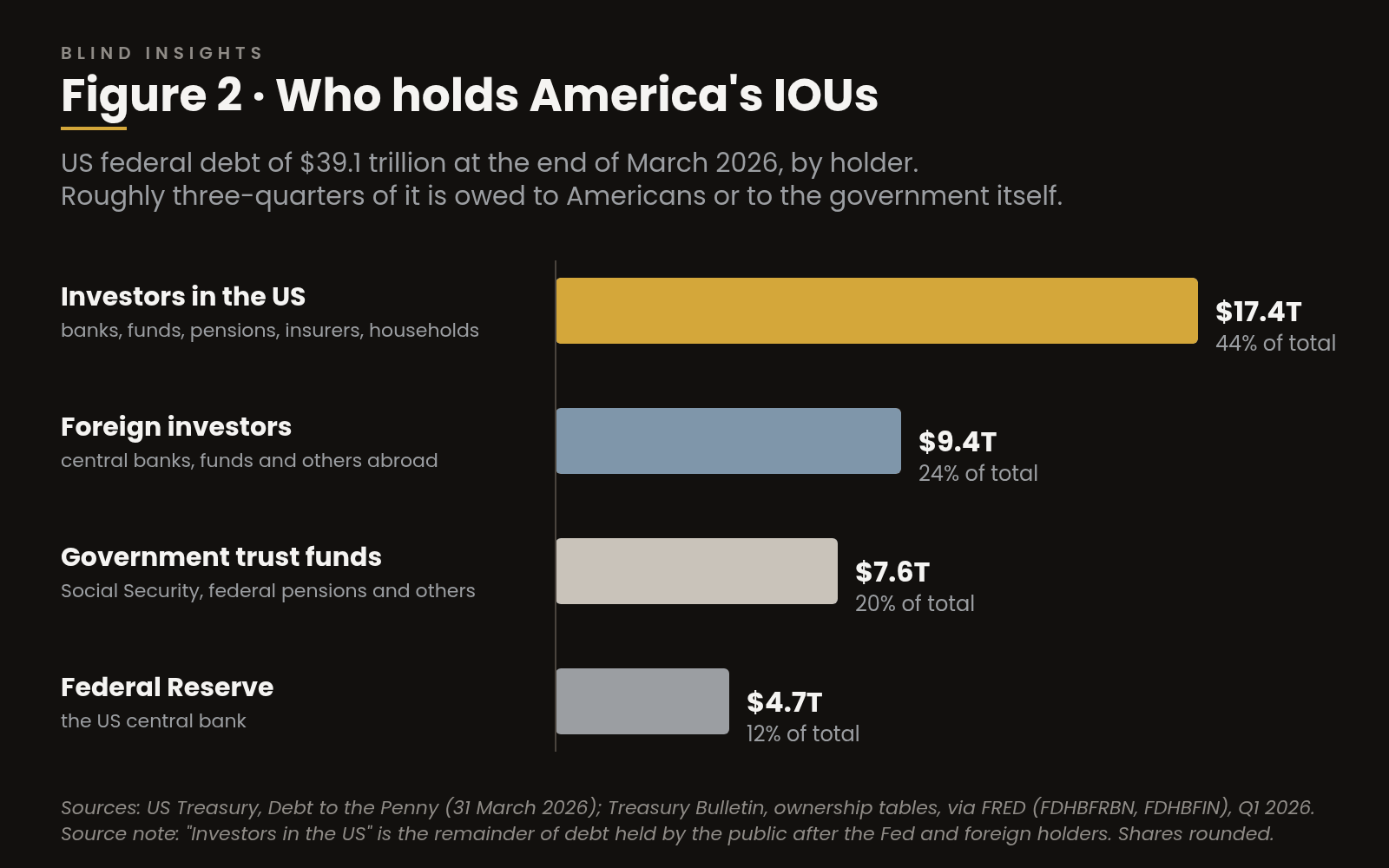
The US Treasury publishes the answer. At the end of March 2026 — the most recent quarter with a full breakdown by holder — total federal debt stood at about 39.1 trillion dollars. It split into four groups:
- Investors in the United States — banks, mutual and money market funds, pension funds, insurers, state and local governments and ordinary households — held about 17.4 trillion dollars, or 44 percent. This is the largest group by a wide margin.
- Foreign investors — foreign central banks, governments, funds and companies — held about 9.4 trillion dollars, or 24 percent.
- The government’s own trust funds — most famously Social Security, along with federal employee pension funds and others — held about 7.6 trillion dollars, or 20 percent.
- The Federal Reserve, the US central bank, held about 4.7 trillion dollars, or 12 percent.
Add the first, third and fourth groups together and the headline answer is plain: roughly three-quarters of the national debt is owed to Americans, to American institutions, or to the government itself. The faraway creditor of popular imagination holds about one dollar in four.
The strange part: the government owing itself
Two of those four groups deserve a closer look, because they sound like a paradox.
Start with the trust funds. When Social Security collected more in payroll taxes than it paid out in benefits, the surplus didn’t sit in a vault; by law it was invested in special Treasury securities. So one arm of the government holds the IOUs of another. That debt is real — those securities are the trust fund’s claim to future benefit money — but it’s a promise between parts of the same government, not a loan from outside. That’s why official statistics separate “intragovernmental holdings” from “debt held by the public.” When people argue about the size of the debt, they are often, without saying so, using two different numbers.
Then the Federal Reserve. The Fed doesn’t buy Treasury bonds with money it saved up; when it buys them in the market, it pays by creating new bank reserves — the process described in our piece on how money is created. The Treasury then pays interest on those bonds to the Fed, and the Fed, after covering its own costs, is required by law to hand any profits back to the Treasury. So for the slice the Fed holds, much of the interest makes a round trip. This is not a free lunch: the Fed’s purchases add money to the system, which is why they are a tool of monetary policy and a recurring source of argument about inflation. But “owed to the central bank” is a very different thing from “owed to a stranger who can call the loan.”
What about foreign holders?
Then there’s the slice that makes the headlines. About a quarter of the debt is held abroad — but not by one country, and not by one kind of holder. It is spread across many countries and includes foreign central banks keeping reserves in dollars, banks, pension funds, and companies that earn dollars through trade and need somewhere safe to park them.
Two common fears don’t survive contact with how bonds work. First, a foreign holder cannot “call in” the debt. A Treasury bond pays on its schedule; the only thing a holder can do early is sell it to someone else in the market. Second, a large sale would not send the government a bill — it would push down the bond’s price and push up its yield, making new borrowing somewhat more expensive. That is a real effect worth watching, but it is a question of price, not of a creditor knocking on the door. Foreign holders own US debt largely because it is the deepest, most liquid safe asset in the world, and that demand is something the country benefits from as much as it depends on.
Why it still matters
If most of the debt is owed “to ourselves,” does that mean it doesn’t matter? No. A debt owed within a country still has costs; they just show up differently.
The first cost is interest. Every dollar of interest the government pays is a dollar that must come from taxes, from spending elsewhere, or from more borrowing. It goes to the bondholders — which, as we’ve seen, is mostly domestic savers and institutions. So the interest bill is less a payment to outsiders than a transfer from taxpayers in general to bondholders in particular, and when it grows, it crowds the rest of the budget.
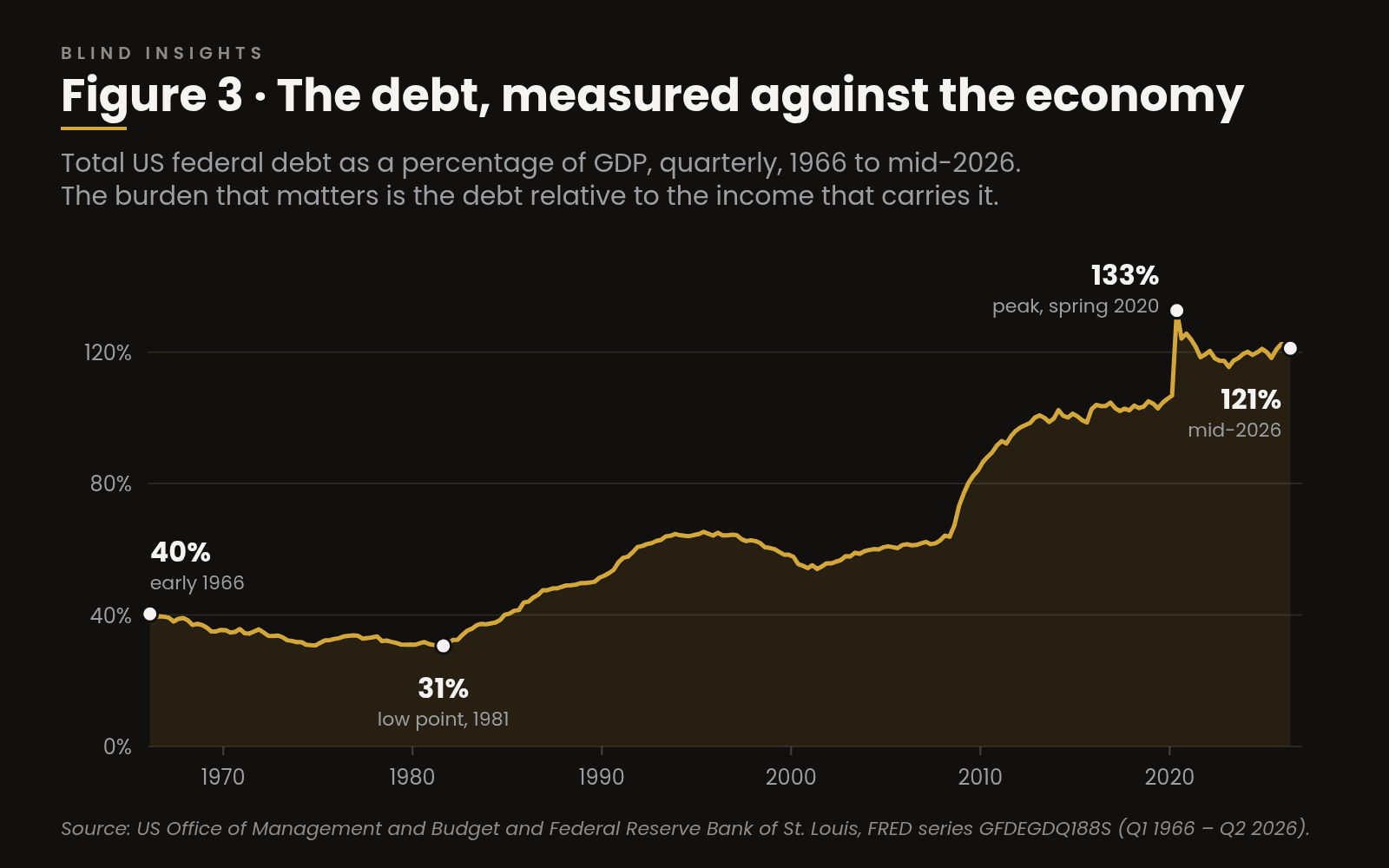
The second is scale relative to income. A debt only means something next to the income that has to carry it, just as the same mortgage means something very different to a family on a modest income than to one earning ten times as much. For a country, the income is the whole economy, so the honest measure is debt compared with GDP. By that yardstick, US federal debt was about 40 percent of the economy in early 1966, fell to a low of about 31 percent in 1981, then climbed in steps — sharply after the financial crisis, and again during the pandemic, when it peaked near 133 percent in spring 2020. In mid-2026 it stood at about 121 percent.
The third is who bears the adjustment. A country that borrows in its own currency won’t be forced to default the way a household can be, because it can always issue more of that currency. But that escape hatch has a price, and it is paid through inflation — eroding the purchasing power of exactly the savers who hold the bonds. That mechanism has a name, and we’ve looked at it in detail in the quiet tax of financial repression.
What this is not
This is not an argument that the debt is harmless, nor that it is a looming catastrophe — both claims are made loudly, and neither is settled by who holds the bonds. It is not a forecast of interest rates, inflation, or the next budget fight. And it is not advice about whether to own government bonds; that depends entirely on your own situation. It is one clarifying idea: that the national debt is a stack of IOUs, that every one of them is someone’s savings, and that most of those someones are closer to home than the headlines suggest.
The question to keep
So the next time someone waves the national debt at you as a single terrifying number, set the number aside for a moment and ask the questions that actually tell you something:
Who holds this debt — and is it owed to outsiders, to savers at home, or to the government itself? And measured against the income of the whole economy, is the burden of carrying it growing or shrinking — and who, in the end, is quietly paying for that?
We are not here to tell you whether the debt is too high. We are here to make sure that when the subject comes up, you see what’s actually there — a vast web of IOUs connecting taxpayers, savers and the state — instead of a faceless creditor waiting at the door.
Blind Insights — clarity on money, the economy, and power. We look beneath the surface, because that is usually where the answer is. More at blindinsights.de