Ask most people where money comes from and they will say the government prints it. That answer is almost entirely wrong — and the truth changes how you read the entire economy.
There is a picture in nearly everyone’s head of how money works. The government, or the central bank, runs a printing press. Notes come out. That is the money supply. It is a tidy image, and it is false for the overwhelming majority of the money that actually exists.
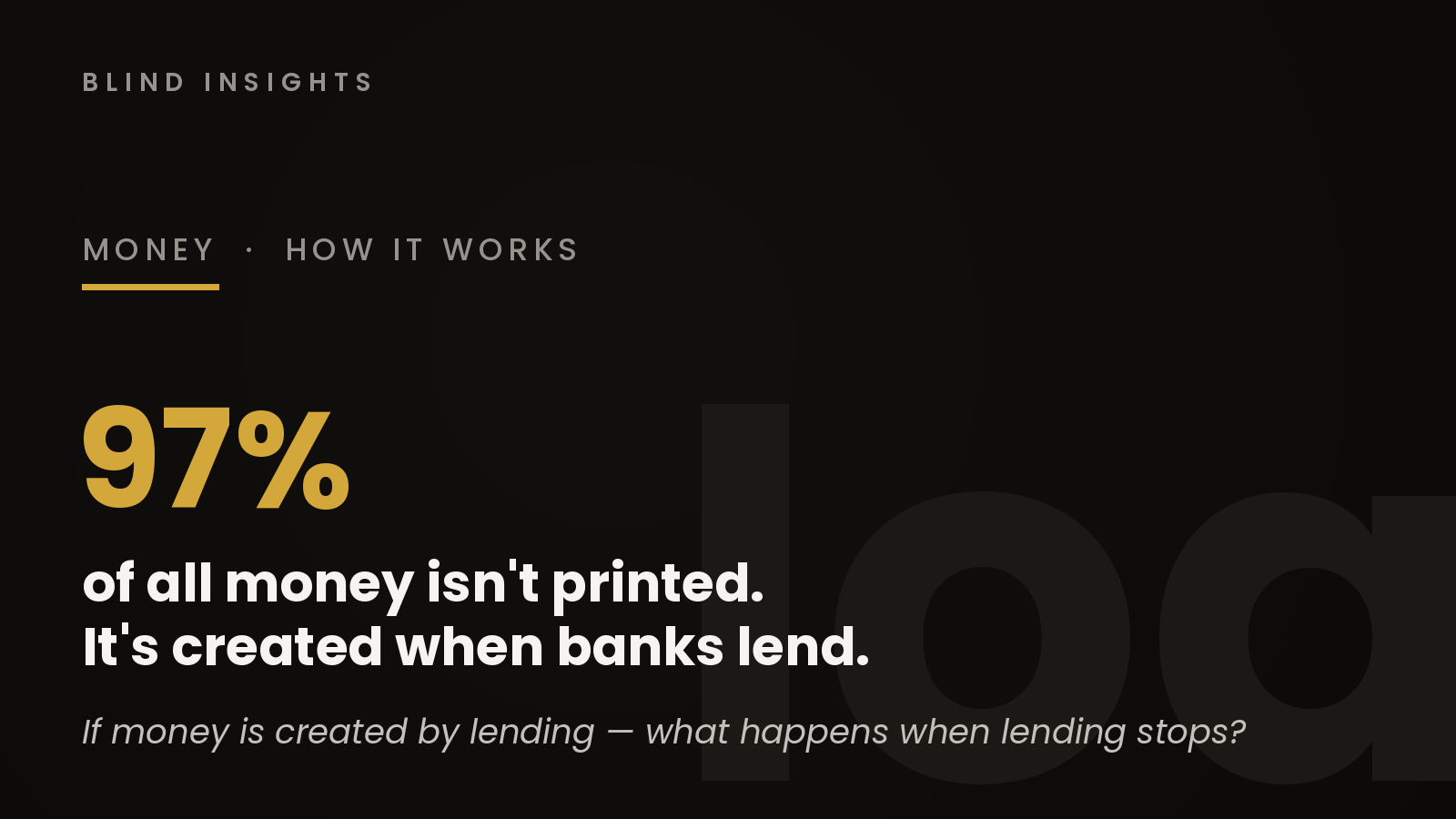
In a modern economy, physical cash — notes and coins — makes up only a small slice of all money, on the order of a few percent. The rest, something like ninety-seven percent, exists only as numbers in bank accounts. And those numbers are not created by a government printer. They are created by commercial banks, in the ordinary act of making a loan.
That sentence sounds like a technicality. It is, in fact, one of the most important and least understood mechanisms in economics.
Where the money actually comes from
Here is the part that surprises people. When a bank gives you a loan, it does not reach into a vault of other people’s deposits and hand you their money. It creates new money, on the spot, by typing a number into your account.
Picture it concretely. You are approved for a one-hundred-thousand mortgage. The bank does not move a hundred thousand from a saver’s account to yours. It writes “100,000” into your account as a deposit, and “100,000” as a loan you owe. Both sides appear at the same instant. The deposit is new money — money that did not exist a moment earlier. It was not transferred. It was created.
This is not a fringe theory. It is the mainstream description of how banking works, confirmed plainly by central banks themselves. The textbook image of a bank as a middleman that gathers deposits and lends them out is, at best, a simplification — and at worst, the source of a deep public misunderstanding.
Then what stops banks creating infinite money?
If a bank can conjure money by lending, the obvious question is why it doesn’t create an unlimited amount. The answer is that creation is constrained, just not in the way most people assume.
A bank is limited by several real brakes. It needs borrowers who are creditworthy and willing to take loans. It must hold capital against those loans to absorb losses. It must be able to settle payments with other banks when the borrowed money is spent and moves elsewhere. And it operates under the central bank’s interest rate, which makes borrowing more or less attractive. These constraints are real. But notice what they are: they govern the pace of money creation. They do not change the fact that lending is what creates it.
This is why the health of an economy is so tightly bound to the willingness of banks to lend and of people to borrow. The money supply is not a fixed pool the government tops up. It expands when lending expands, and it contracts when loans are repaid faster than new ones are made.
Why this matters to you
Once you see money this way, several things that seemed mysterious start to make sense.
It explains why economies can seize up so suddenly. If money is created by lending, then a moment when banks stop lending and borrowers stop borrowing is not a slowdown — it is the money supply itself shrinking. Credit and money are nearly the same thing, which is why a “credit crunch” is so dangerous.
It explains why central banks obsess over interest rates: the rate is one of the few levers that influences how eagerly the whole system creates money. And it reframes government and personal debt, because in a system where money is born as debt, someone’s debt is the structural counterpart of someone else’s money.
What this is not
This is not a claim that the system is a fraud, or that banks are doing something secret or illegal. They are not. The mechanism is documented, regulated, and openly described by the institutions that run it. Nor is it an argument that money creation is inherently bad — credit creation is part of how investment and growth happen.
It is simply a correction to a picture that almost everyone carries and almost no one questions.
The question to keep
So the next time you hear that the government is “printing money,” or that banks “lend out savings,” pause on the mechanism underneath:
If most money is created by private banks every time they make a loan — and destroyed when loans are repaid — then who really controls the money supply? And what does it mean that the thing we all work for is, at its root, somebody else’s debt?
We are not here to tell you whether that system is good or bad. We are here to make sure you can see how it actually works — because almost everything else in economics is built on top of it.
Blind Insights — clarity on money, the economy, and power. We look beneath the surface, because that is usually where the answer is. More at blindinsights.de