“Are we in a recession?” is one of the most anxiously searched questions in the world, usually asked by people who’ve never been given a straight answer about what a recession actually is. The popular definition is wrong, the real one is more interesting, and the most useful fact of all is this: by the time anyone can tell you for certain, the worst is often already behind you.
Few words in economics carry as much dread, or as little clarity, as “recession.” People know it means bad — layoffs, fear, belts tightening — but ask for an actual definition and most reach for the same half-remembered rule: “two quarters of negative growth.” That rule is a decent rough-and-ready signal, but it is not what a recession is, and leaning on it will mislead you at exactly the moments that matter. So let’s build the real picture from the ground up.
First, the thing a recession is part of
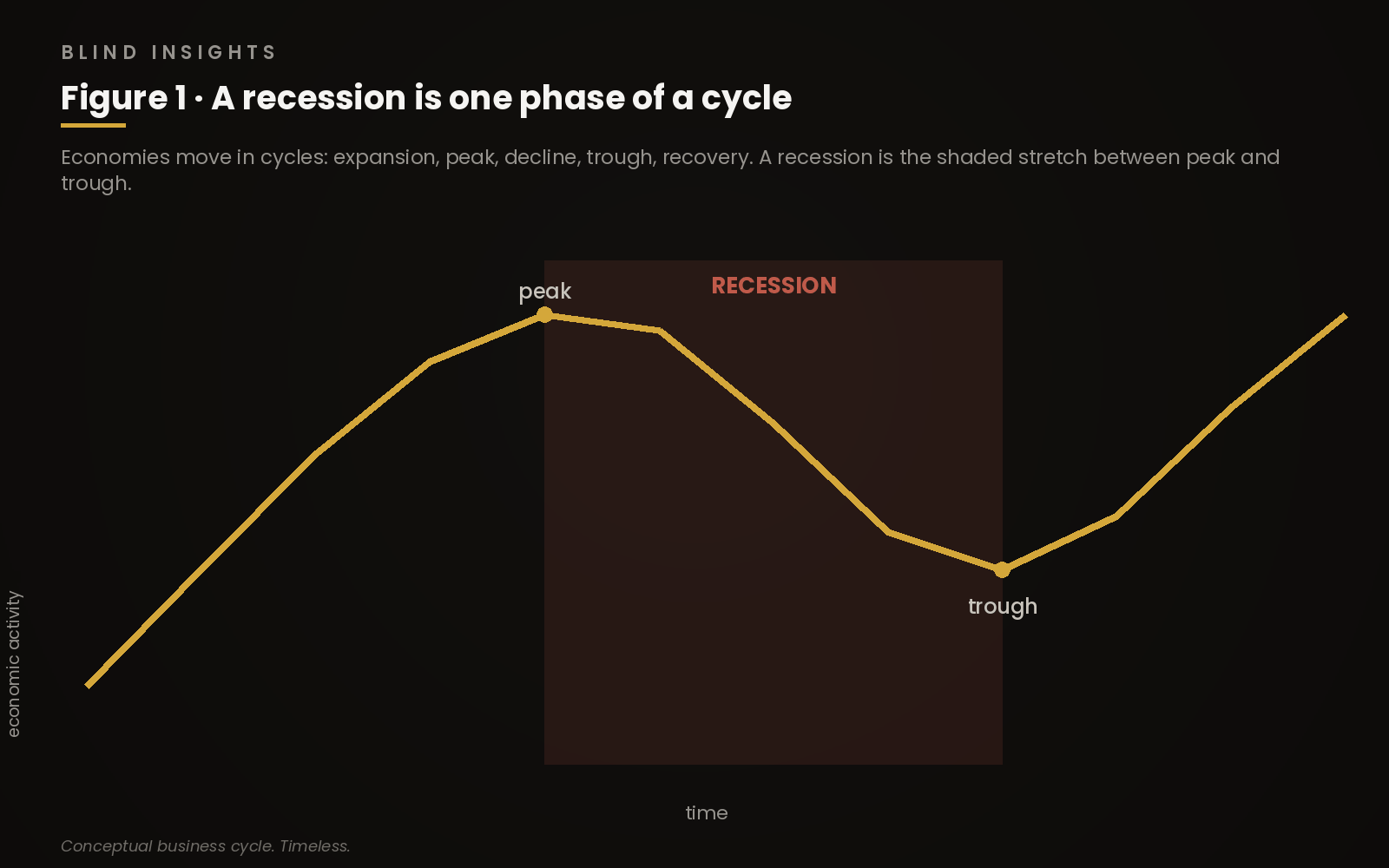
You can’t understand a recession without understanding the cycle it belongs to. Economies don’t grow in a straight line. They move in waves: a period of expansion, where activity, jobs and spending grow; a peak, where growth tops out; a decline, where activity falls; a trough, the low point; and then a recovery, where it starts climbing again. This up-and-down rhythm is called the business cycle, and it is as normal to an economy as breathing.
A recession is simply one phase of that cycle: the stretch between the peak and the trough, when the economy is broadly shrinking rather than growing. It is not an alien event that strikes from outside — it is the down-leg of a wave the economy was always going to have. That reframing matters, because it turns “recession” from a monster into a recognisable, recurring part of how economies work.
Why “two bad quarters” is the wrong definition
Now the correction. The famous “two consecutive quarters of falling GDP” rule is popular because it’s simple and you can check it with one number. But the people who actually decide when a recession happened don’t use it, and for good reason.
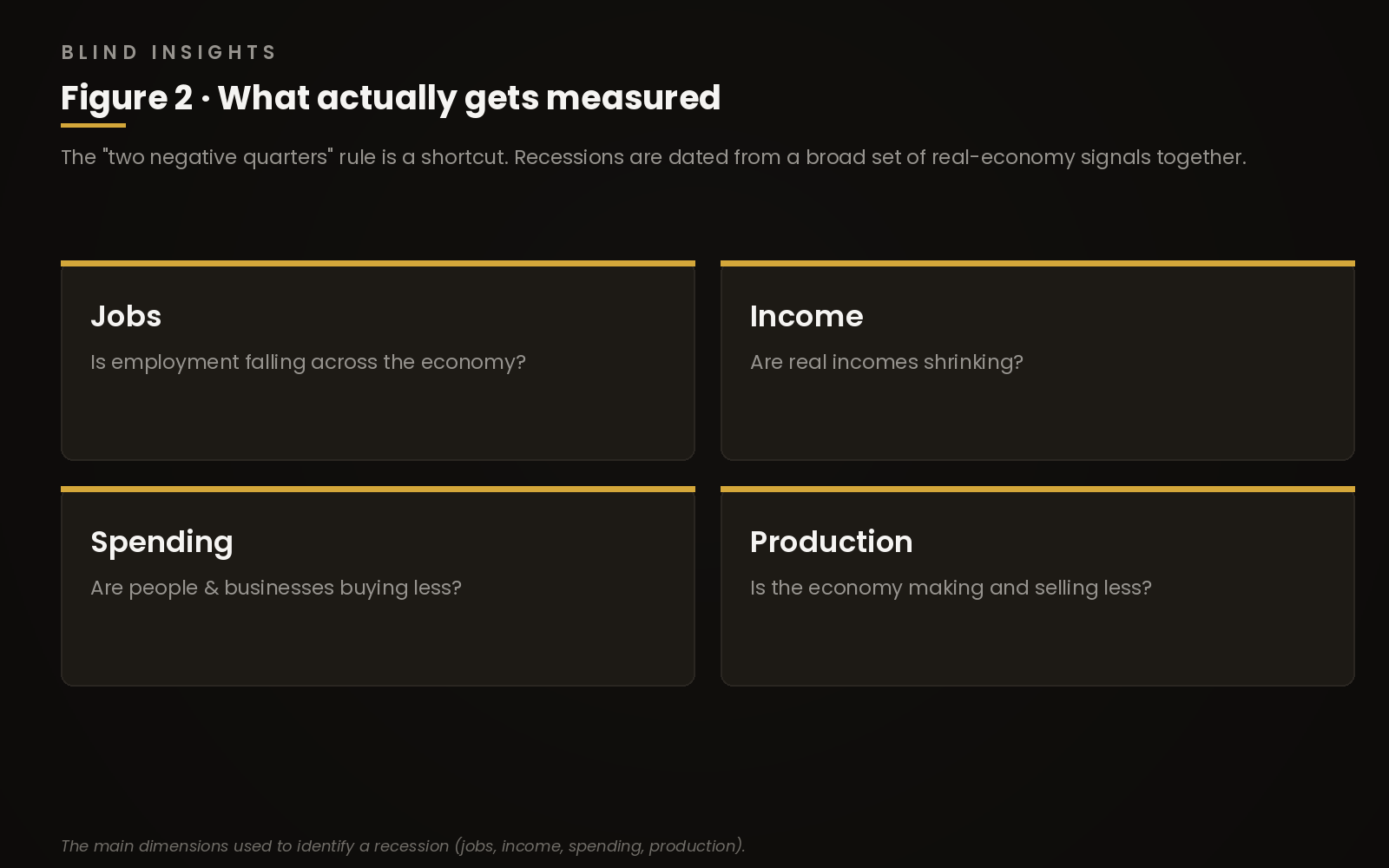
A real recession isn’t defined by a single statistic ticking down twice. It’s defined by a decline that is deep, broad, and lasting — a downturn you can see across the whole economy at once, not in one indicator. The bodies that officially date recessions look at a range of real-world signals together: are jobs being lost across many industries? Are people’s real incomes falling? Is spending dropping? Is the economy actually producing and selling less? A genuine recession shows up in all of them, sustained over time. One weak quarter of GDP — which can be caused by a quirk, a one-off, or data noise — doesn’t qualify, and the economy can even have two soft quarters without the broad, deep damage that defines the real thing.
The shortcut, in other words, can flash red when nothing’s wrong, or stay quiet while real damage spreads. The fuller picture is the one that tells the truth.
The most useful fact: you always find out late
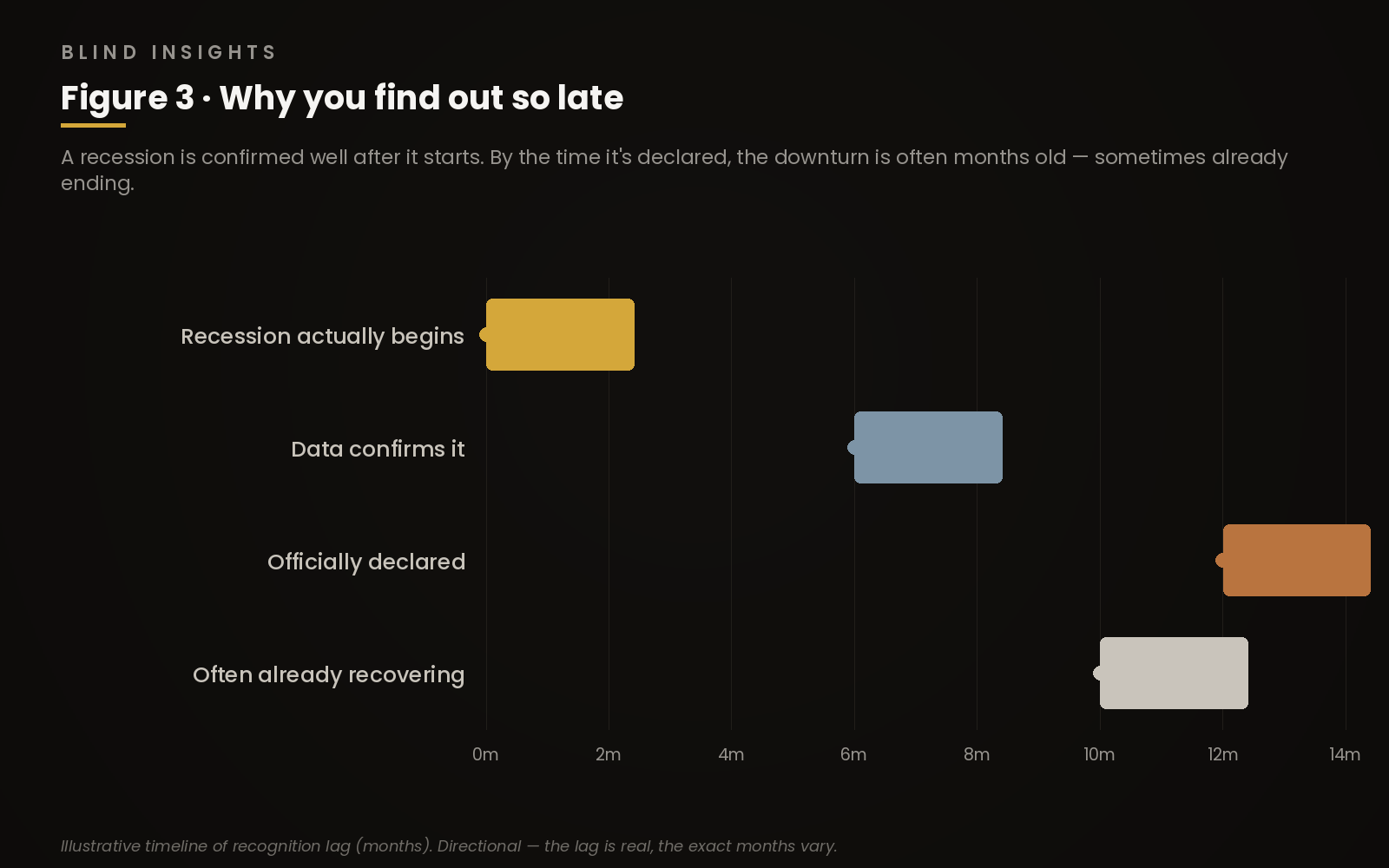
Here is the part that is genuinely practical, and that almost no one tells you. You will never know you’re in a recession while it begins. The confirmation always arrives late — often very late.
There are two reasons. First, the data is slow: the figures that reveal a downturn are collected, published, and then revised over months, so the clear picture only forms well after the fact. Second, officially dating a recession is a deliberate, cautious process — the people responsible wait until they’re sure, precisely so they don’t cry wolf. The result is a long lag between when a recession actually started and when anyone declares it. By the time you read “it’s official, we’re in a recession,” the downturn is frequently months old. And here’s the twist that catches people out: because recessions are one phase of a cycle, the economy is often already climbing out of the trough — recovering — at the very moment the recession is finally confirmed. The scariest headline can land just as the worst is ending.
What this means for how you read the news
Put these three together and the practical lesson almost writes itself. Reacting to the label — panicking when “recession” is finally declared, relaxing when it’s officially over — means reacting to old news, often in exactly the wrong direction. The declaration is a backward-looking confirmation, not a forward-looking warning. The useful move is to watch the broad, real signals (jobs, incomes, spending) as they trend, and to treat the official label as what it is: a historian’s verdict, arriving after the events it describes, not a starting gun.
What this is not
This is not a prediction that a recession is or isn’t coming — that’s exactly the kind of call the lag makes genuinely hard, and anyone who’s certain is guessing. It is not a claim that GDP is useless; it’s one important signal among several, just not the whole definition. And it is not advice on what to do with your money when a downturn hits — that depends entirely on your own situation. It is one clarifying idea: that a recession is a normal phase of a cycle, defined by breadth and depth rather than a single rule, and confirmed so late that the label tells you about the past, not the future.
The question to keep
So the next time a headline asks “are we in a recession?” — or triumphantly declares one — don’t take the label at face value, in either direction. Ask the questions that actually matter:
Are the broad, real signals — jobs, incomes, spending across the whole economy — trending down together, or is this one noisy number? And given that the official answer always arrives months late, is this news telling me where the economy is heading, or merely confirming where it has already been?
We are not here to tell you whether the next downturn has arrived. We are here to make sure that when the word “recession” starts flying around, you understand what it really means, who decides, and why the calendar matters as much as the number — so you’re reading the economy, instead of reacting to a label that’s always a step behind it.
Blind Insights — clarity on money, the economy, and power. We look beneath the surface, because that is usually where the answer is. More at blindinsights.de