The stock market is talked about constantly and understood rarely. People know it goes up and down, that fortunes are made and lost in it, that it’s somehow central to the economy — but ask what a share actually is, or where its price really comes from, and most draw a blank. So here is the whole machine, built from the ground up, in plain language — including the single distinction that separates investing from gambling.
For something so central to modern life, the stock market is wrapped in a strange fog. The news reports it like weather — “stocks rose today,” “markets tumbled” — as if it were a mysterious force with a mood. Films portray it as a casino for the rich. And most people, even many who own shares through a pension, have never been told the simple mechanics underneath. Let’s clear the fog, because the core of it is genuinely simple, and understanding it changes how you see a great deal else.
What a share actually is
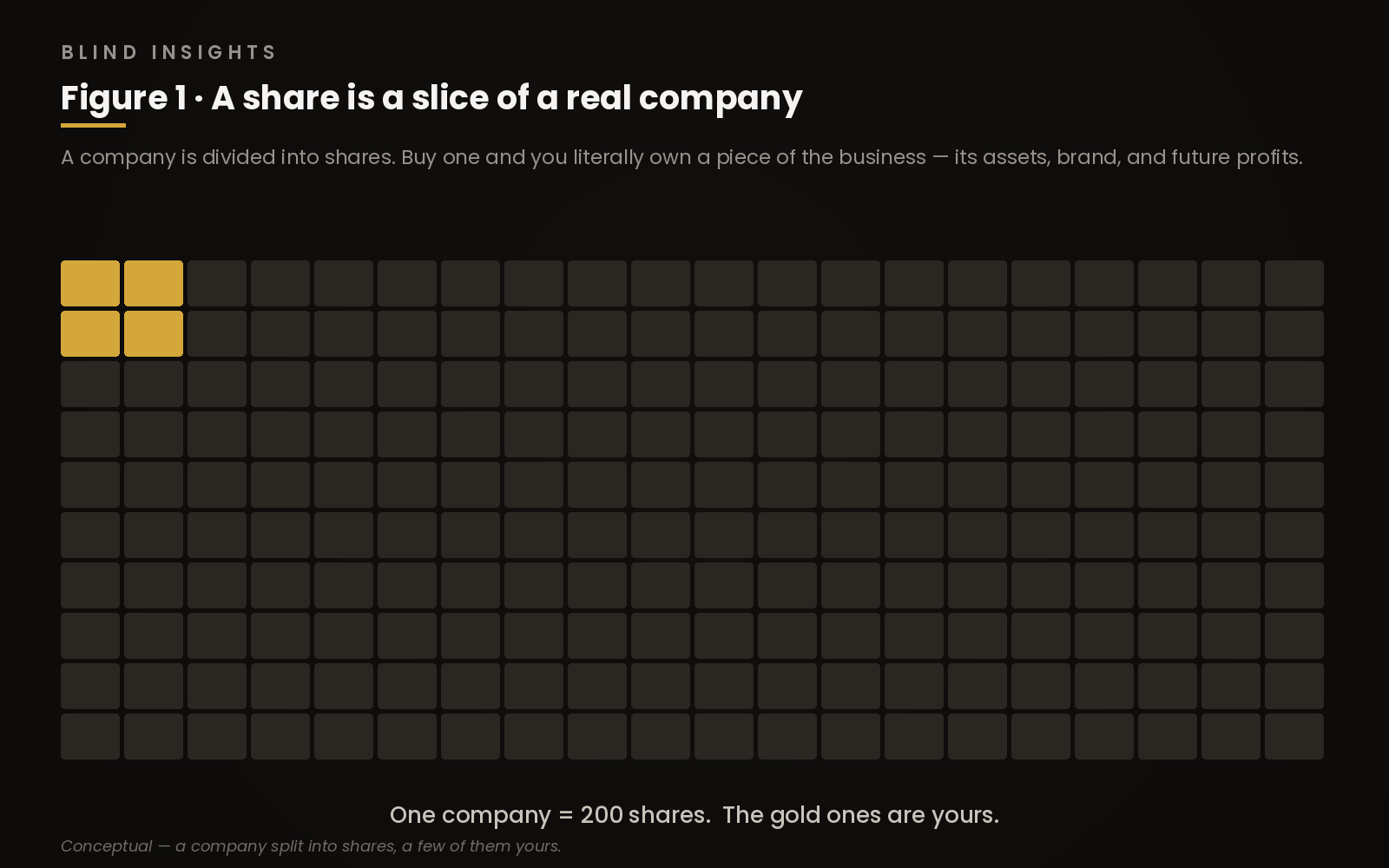
Start with the thing itself, because everything flows from it. A company — a real business, with employees, products, buildings, profits — can divide its ownership into a large number of equal pieces. Each piece is called a share. When you buy a share, you are buying, quite literally, a small slice of ownership in that actual business.
This is the point that most people never fully absorb, and it changes everything: a share is not an abstract betting chip whose number happens to go up and down. It is a piece of a company. Own a share of a business and you own a fraction of its factories, its brand, its cash, and — the part that matters most — its future profits. If the company does well over the years, your slice of it becomes worth more, and the company may even pay out part of its profits directly to you (a dividend). You are a part-owner, not a spectator placing a bet.
Hold onto that, because it is the foundation the entire rest of the market sits on.
Where the market comes from
So why is there a “market” at all? Two reasons, and they’re both practical. First, companies sometimes want to raise money — to build a factory, expand, invest — and one way to do it is to sell new shares to the public, taking in cash in exchange for slices of ownership. That’s a company “going public.” Second, and this is where the daily action lives: once those shares exist, the people who own them want to be able to sell them to someone else, and other people want to buy them. The stock market is simply the organised place where those buyers and sellers meet and agree on prices. That’s all an exchange is — a vast, continuous marketplace for slices of companies.
Crucially, most of what happens on the market day to day is this second kind: people trading existing shares with each other. When a stock “rises,” the company itself usually doesn’t receive a cent — ownership of its slices is just changing hands at a higher price.
Price is not the same as value
Here is the single most important idea in the whole subject, and the one that separates people who understand markets from people who are mystified by them: a stock’s price and its value are not the same thing.
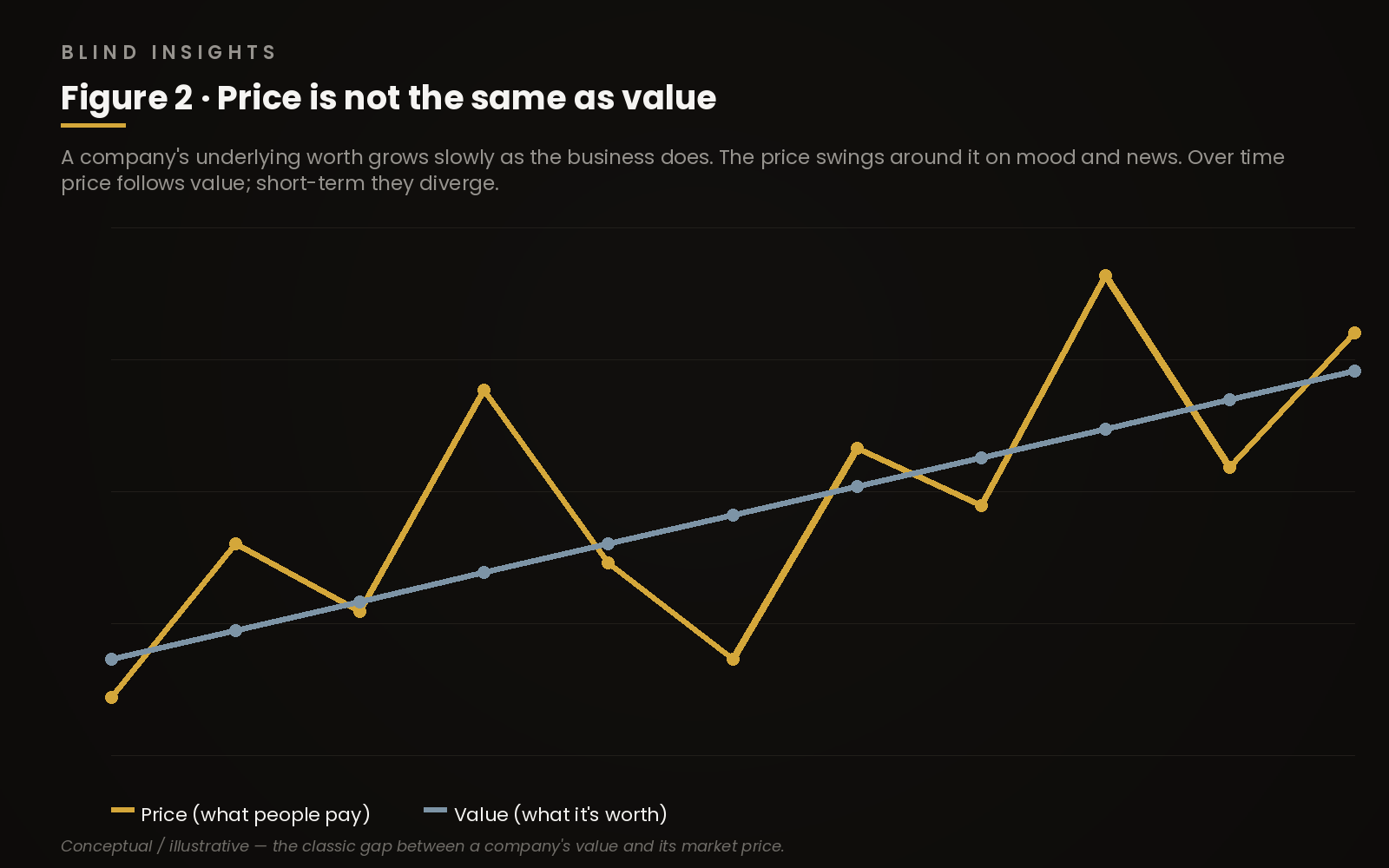
The value of a share is what the underlying business is genuinely worth — a reflection of its profits, assets, and realistic prospects. This tends to change slowly, because real businesses change slowly. The price is something else: it’s merely what buyers and sellers happen to be agreeing on at this exact moment. And price is driven not only by value but by emotion, news, fear, excitement, and the herd — all of which can swing wildly from day to day. So the price dances around the value: sometimes above it (when people are excited), sometimes below it (when people are scared), occasionally far from it in either direction.
Over the long run, price tends to drift back toward value — a genuinely good business usually gets recognised eventually, and an overhyped one usually gets found out. But in the short run, the two can part ways dramatically. This gap is where nearly everything interesting in investing happens, and holding the distinction firmly is what keeps you sane when the price does something the business plainly didn’t.
What actually makes a price move
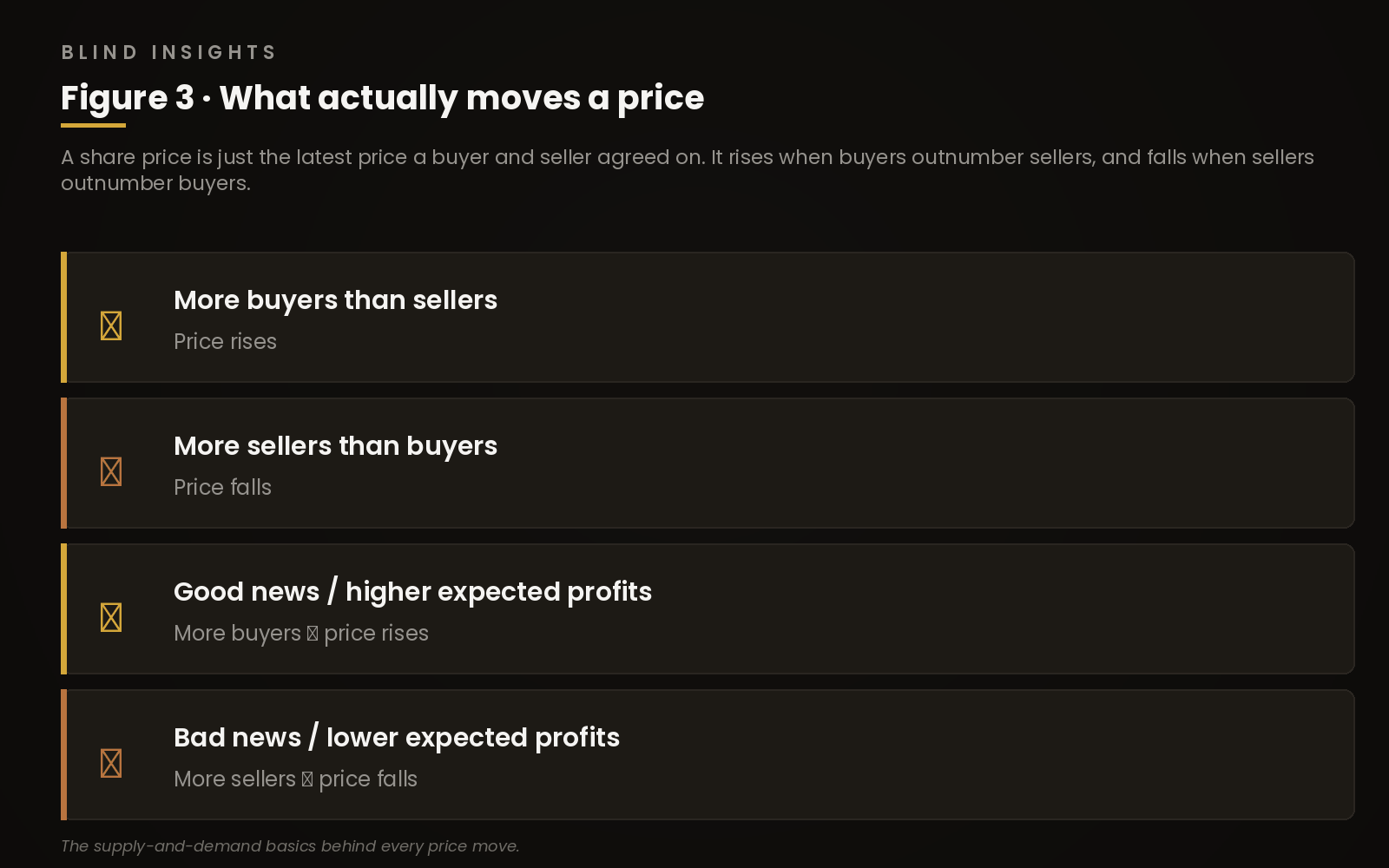
If price is just what buyers and sellers agree on, then a price moves for exactly one reason: the balance between buyers and sellers shifts. When more people want to buy a share than sell it, the price gets bid up. When more want to sell than buy, it drops. That’s the whole engine — supply and demand, the same force that sets the price of anything.
This is why news “moves” a stock. A good earnings report or an exciting announcement doesn’t magically change the price by itself — it changes the price by making more people want to buy (and fewer want to sell), which tips the balance upward. Bad news does the reverse. The news is just the thing that shifts the crowd; the crowd shifting is what actually moves the price. Once you see this, “the market reacted to the report” stops being mysterious and becomes mechanical.
Investing vs. gambling — the line that matters
Now the distinction that ties it all together and that genuinely matters for how you behave. Because a share is a piece of a real business, you can buy it for a sensible reason: you believe the business will do well over time, earn more, and become worth more — so your slice will too. That is investing: owning a piece of something productive and giving it time to grow. It leans on value, and it has the long run on its side.
Or you can buy a share purely hoping its price goes up in the short term — not because you’ve judged the business, but because you’re betting the number moves your way before you sell. That’s closer to gambling: wagering on price swings, where you have the short-run mood of the crowd against you and no underlying growth on your side. The share can be identical; what differs is which of the two things — the value or the price — you’re actually betting on. That single choice is the real dividing line, and almost everything sensible ever written about markets is, underneath, a version of it.
What this is not
This is not advice to buy shares, or any particular share — whether, when, and how much to invest depends entirely on your own situation and risk tolerance, and shares can and do lose value. It is not a promise that stocks always go up; over the long sweep they historically have, but there are no guarantees and plenty of painful stretches. And it is not a trading system or a tip. It is one clear foundation: that a share is real ownership, that price and value are different things, and that the gap between them is where both the opportunity and the danger live.
The question to keep
So the next time you hear that “the market” did something, or you’re tempted by a stock because the number is climbing, step back to the foundation and ask the question that actually matters:
Am I buying a piece of a business I believe will genuinely grow — betting on its value over time — or am I just betting that the price will go up before I sell? Because those are two completely different acts wearing the same ticker symbol, and knowing which one you’re doing is the whole difference between investing and gambling.
We are not here to tell you what to buy. We are here to make sure that when you look at the stock market, you see what’s actually there — slices of real businesses, priced by a restless crowd — instead of a mysterious machine that goes up and down for reasons no one will explain.
Blind Insights — clarity on money, the economy, and power. We look beneath the surface, because that is usually where the answer is. More at blindinsights.de