Executive Summary
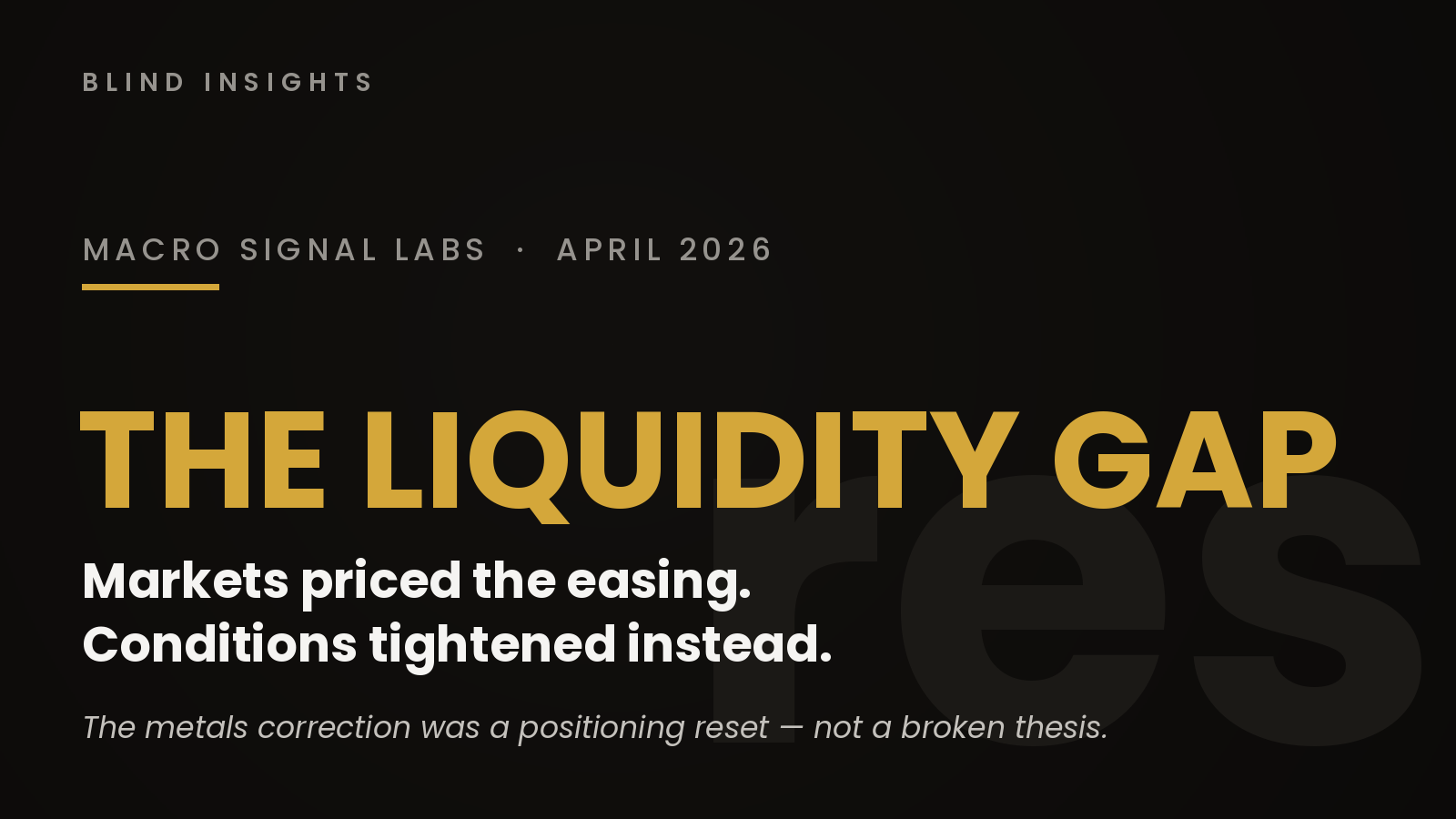
Markets are discovering that liquidity expectations and liquidity reality are not always the same thing. This is a structural read of the repricing — not a set of recommendations.
April 2026 marked one of the most important repricing phases of the year so far. The defining factor across global markets was not growth, inflation, or monetary policy in isolation, but the adjustment of liquidity expectations. Investors who entered the year expecting an uninterrupted continuation of risk appetite were forced to reassess their assumptions around capital flows, financial conditions, and policy timing.
The most visible consequences appeared in precious metals: gold corrected meaningfully while silver fell substantially more. Although many participants read the move as a breakdown of the longer-term bullish thesis, the evidence points the other way — the correction reflects positioning, leverage, and liquidity dynamics rather than a structural deterioration of the macro backdrop.
Meanwhile, the AI investment cycle continues to expand beyond software and semiconductor narratives into infrastructure, power generation, energy demand, and industrial capacity. The environment remains fragmented, volatile, and increasingly dependent on how liquidity is actually transmitted.
Liquidity Expectations versus Reality
For much of the previous cycle, markets benefited from abundant liquidity and predictable monetary support. April demonstrated that expectations for future liquidity can become disconnected from actual liquidity conditions. Financial conditions tightened despite expectations for eventual easing, and markets repriced accordingly.
The lesson underneath the volatility is a simple one: it is not enough to be right about the direction policy will eventually take. What moves markets in the meantime is the gap between what was priced and what was delivered — and in April, that gap widened.
Precious Metals Reset
Gold corrected roughly ten percent from recent highs. Silver fell substantially more, owing to its hybrid role as both a monetary and an industrial asset. The move is consistent with prior liquidity-driven positioning resets rather than a structural trend reversal.
This is the distinction that matters, and the one most commentary skips: a price falling because the underlying thesis broke is a different event from a price falling because a crowded, leveraged position unwound. The first is a reason to reconsider; the second is mechanics. The evidence in April points to the second.
Commodities & Energy
Energy remains the most important transmission mechanism between geopolitics and inflation. Commodity markets continue to reflect constrained supply despite weaker sentiment — a reminder that price and physical tightness do not always move together.
The AI Infrastructure Cycle
AI remains one of the strongest structural investment themes globally. The next phase is increasingly driven by physical infrastructure requirements rather than software adoption alone — power generation, grid expansion, data centres, semiconductors, and industrial equipment. The theme is intact; what changes is where in the chain the pressure now sits.
Regional Macro Outlook
United States — economic activity remains relatively resilient despite tighter financial conditions.
China — policy support remains targeted and selective rather than broad.
Latin America — commodity-exporting economies continue to benefit from structural demand trends.
Risk Scenarios
Rather than a point forecast, the outlook is framed as probability-weighted scenarios.
Base case (50%) — moderate growth, sticky inflation, gradual liquidity improvement.
Bull case (25%) — accelerated liquidity expansion and stronger risk-asset performance.
Bear case (25%) — further tightening, economic slowdown, renewed commodity volatility.
Key Takeaways
Markets are repricing liquidity expectations. The precious-metals correction appears cyclical rather than structural. The AI infrastructure cycle remains intact. Commodity markets continue to reflect supply-side constraints. And across all of it, regime analysis remains more valuable than short-term forecasting.
We are not here to tell you where liquidity goes next. We are here to make sure that when the market confuses the story it expected with the conditions it actually got, you can tell the two apart.