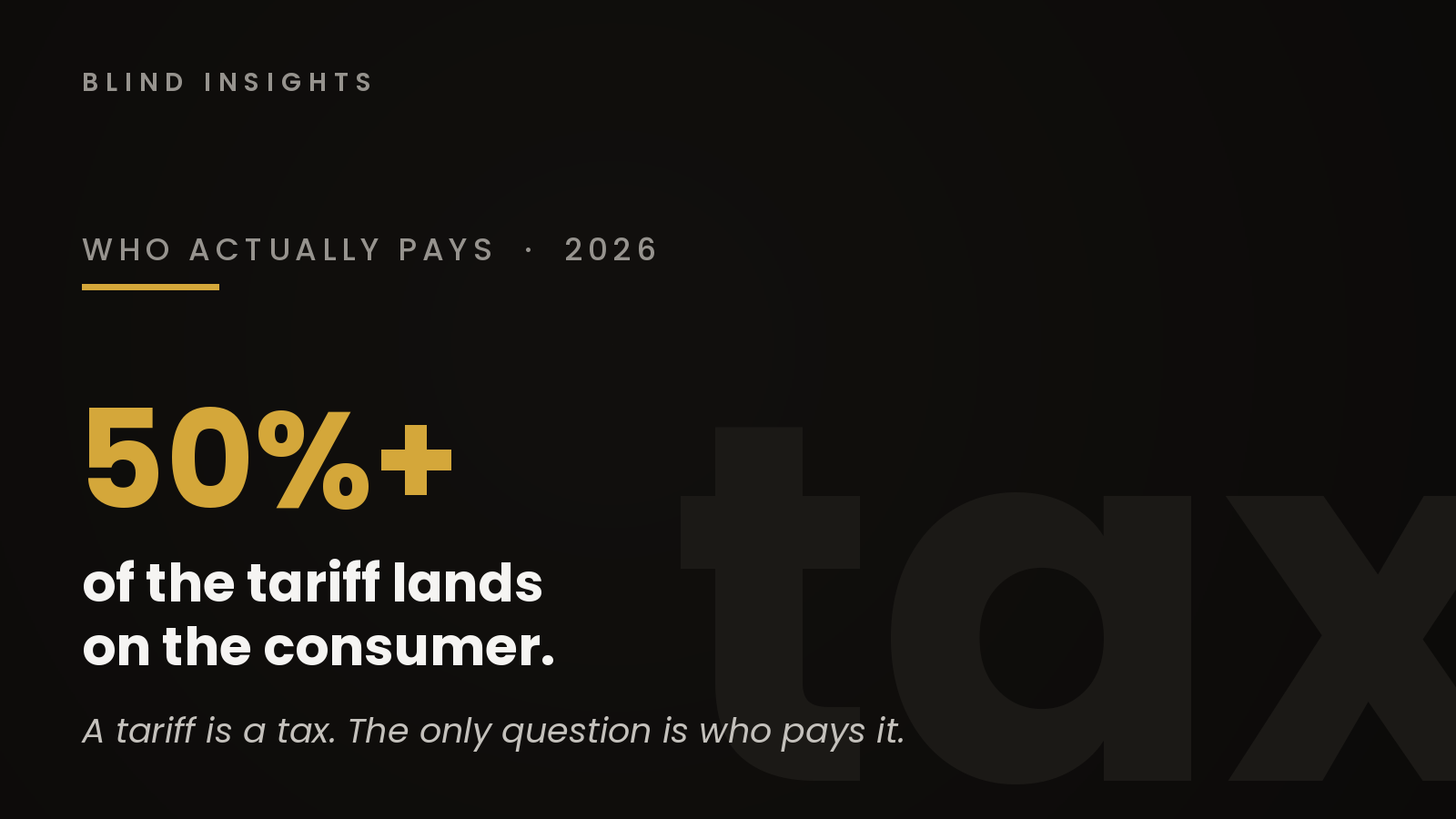
A tariff is described as a tax on foreign goods. The word “foreign” does a lot of quiet work in that sentence. The more useful question — and the one the politics is built to avoid — is who hands over the money.
A tariff is one of the oldest tools in economic policy, and one of the most consistently misunderstood — not by accident, but because the misunderstanding is politically convenient. It is presented as a charge levied on another country: we tax their goods, they pay, our side benefits. The framing is appealing because it locates the cost somewhere far away, on someone else.
The mechanism does not work that way, and 2026 has provided an unusually clear measurement of how it actually works.
The mechanics, step by step
Follow the money in order, because the order is where the truth hides.
A foreign manufacturer ships a product to a domestic importer. When that product crosses the border, the importer — a domestic company — pays the tariff to its own government. Not the foreign manufacturer. The domestic importer writes the cheque. That is the first fact, and it is not in dispute: the legal payer of a tariff is the company doing the importing, at home.
The importer now has a higher cost. It has three options. It can absorb the cost and accept thinner margins. It can pressure the foreign supplier to cut prices. Or it can pass the cost on to whoever buys the product next — eventually, the consumer. In practice it does some mix of all three, and the proportions are an empirical question, not an ideological one.
What the measurement shows
This is where 2026 is instructive, because the proportions have been measured rather than asserted.
The best available estimates indicate that more than half of the cost of the current tariff regime is now passing through to consumers. Analysts have attributed a measurable increase in inflation specifically to the tariffs — on the order of roughly a percentage point of added price pressure over the relevant period, relative to where prices would otherwise have been.
Note what that pass-through figure means and what it does not. It does not mean foreign exporters pay nothing — some of the cost is indeed eaten abroad through lower supplier prices, and some is absorbed by importers’ margins. But the largest single share lands on the domestic consumer, in the form of higher prices on the shelf. The tax described as falling on foreigners falls, mostly, at home.
Why the framing survives anyway
If the mechanism is this clear, why does the “foreigners pay” framing persist? Because it is structurally useful to whoever is imposing the tariff.
The cost of a tariff is diffuse and delayed — a few cents more on thousands of products, spread across millions of households, showing up weeks or months later, impossible for any individual to trace back to its cause. The political benefit is concentrated and immediate — a visible announcement, a protected industry, a clear story of standing up for the home team. Diffuse costs and concentrated benefits are the exact conditions under which bad-but-popular policy survives. Nobody can feel the tariff in any single purchase, so nobody assigns the blame correctly.
This is not an argument that tariffs are always wrong. Narrowly targeted tariffs can be a legitimate response to genuinely unfair trade practices, and reasonable people defend them. It is an argument that the cost of a tariff should be located honestly — and that “they pay” is, as a description of the mechanism, simply false for the largest share of it.
What this is not
This is not a position on whether any particular tariff is justified. There are real arguments for strategic tariffs, for protecting critical industries, for responding to a trading partner that does not play fair. Those debates are legitimate and we are not adjudicating them here.
It is one mechanical correction, offered so the debate can at least be conducted in honest currency: a tariff is a tax, and the largest share of that tax is paid at home.
The question to keep
So the next time a tariff is announced as a charge on another country, do not argue about whether it is good policy yet. First ask the prior question, the one the announcement is built to skip:
Who writes the cheque, and whose prices go up? Follow that, and the slogan and the mechanism turn out to point in opposite directions.
We are not here to tell you whether the policy is worth it. We are here to make sure you know who is paying for it before you decide.
Blind Insights — clarity on money, the economy, and power. We look beneath the surface, because that is usually where the answer is. More at blindinsights.de