Two of the largest technology companies on earth reported a very good quarter in early 2026. A large share of the profit did not come from selling anything. It is worth understanding why — because it is a textbook lesson in reading an earnings report.
When a company reports its quarterly results, the headline is almost always a single figure: profit, up or down, beating or missing expectations. The market reacts to that number in seconds. Most people never look past it. The discipline that separates a careful reader from a headline-follower is the willingness to ask one more question: where did that profit actually come from?
In the first quarter of 2026, two giant technology firms offered an unusually clean illustration of why the question matters.
The fifty-three-billion-dollar footnote
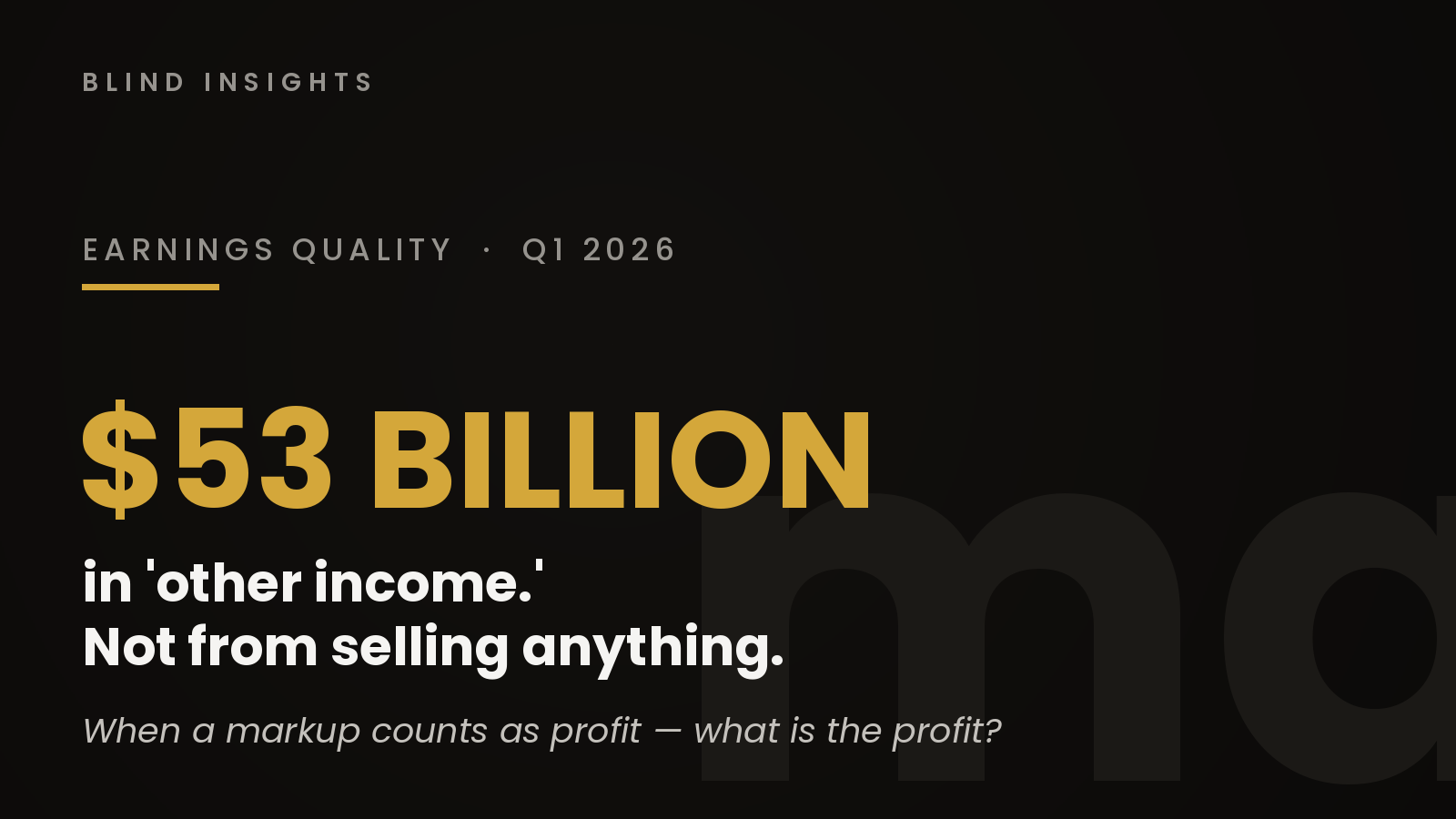
Between them, the two companies booked around fifty-three billion dollars in what is called “other income” — and that line accounted for roughly a third of the combined total income of the wider group they belong to, and the clear majority of those two firms’ own income for the quarter.
“Other income” sounds like a rounding line. Here it was anything but. A large part of it came not from operations — not from cloud computing, not from advertising, not from selling products to customers — but from marking up the value of their stakes in private AI companies.
The chain works like this. These firms are among the biggest investors in the leading private AI labs. Those labs have been raising money at rapidly rising valuations — one prominent lab’s valuation roughly doubled within months. When the valuation of a company you own a piece of goes up, accounting rules let you record that increase as income, even though you have not sold a single share and no cash has changed hands. The gain is real on paper. It is not the same thing as having sold something to a paying customer.
Cash profit and paper profit
This is the distinction at the heart of the matter, and it is not an accusation of wrongdoing. The accounting is entirely legitimate. The point is interpretive.
There are two very different kinds of profit hiding inside one headline number. One is operating profit: a customer paid you money for a thing you provided. That profit is repeatable — you can do it again next quarter, and the quarter after. The other is a mark-to-market gain: an asset you hold became more valuable on paper. That “profit” is not repeatable in the same way. It depends entirely on the valuation continuing to rise. If the valuation falls, the same mechanism runs in reverse and produces a paper loss of identical size, just as suddenly.
A reader who sees only the headline treats both kinds of profit as the same. A reader who looks one line deeper sees that a meaningful part of a celebrated quarter rested on the prices investors are currently willing to pay for private AI companies — the very valuations that the broader bubble debate is about.
Why the two stories connect
This is the quiet link between two headlines that usually run separately: “tech giants report strong profits” and “is AI a bubble.” They are, in part, the same story. When the profits of the largest firms are partly composed of unrealised gains on AI stakes, then the health of those earnings is tied to the durability of AI valuations. If the valuations are sound, the gains are sound. If the valuations are inflated, so is a slice of the profit. You cannot judge one without judging the other.
What this is not
This is not a claim that these companies are weak, or that their results were misleading, or that anyone broke a rule. They didn’t. Mark-to-market accounting is standard, disclosed, and visible to anyone who reads past the first line. Nor is it a prediction that the gains will reverse.
It is a single, portable skill: when a profit number impresses you, find out which part of it came from selling things and which part came from prices moving.
The question to keep
So the next time a company posts a blockbuster quarter, do not stop at the headline. Ask the one question that the headline is designed to discourage:
How much of this profit is cash that customers paid — and how much is the value of things they already owned simply going up on paper?
The two will be presented as one number. Learning to separate them is most of what financial literacy actually is.
Blind Insights — clarity on money, the economy, and power. We look beneath the surface, because that is usually where the answer is. More at blindinsights.de