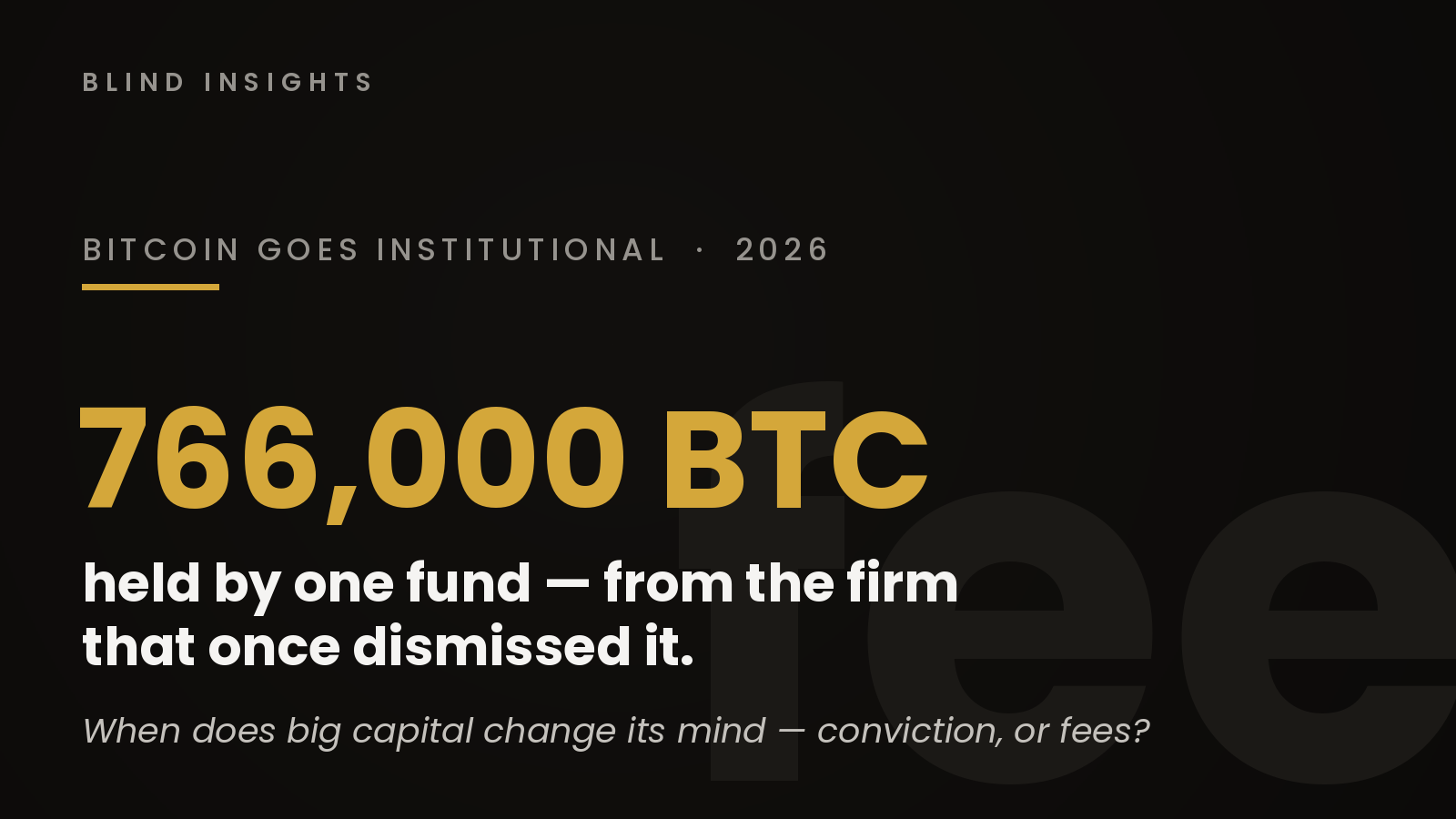
In 2017, the head of the world’s largest asset manager dismissed Bitcoin as an index for money laundering. In 2026, his firm runs one of the largest Bitcoin funds on earth — and has just launched a second. Nothing about Bitcoin changed. Something else did.
The story is told most often as hypocrisy, and hypocrisy makes for a satisfying clip. The chief executive who sneered at an asset now sells it. The man who called it a tool for criminals now collects a fee on it. There is a version of this that is pure entertainment, and it is not wrong, exactly. But it is the shallow read, and the shallow read misses the actual mechanism — which is far more useful to understand.
Because the interesting question is not whether a powerful person changed his tune. People change their minds; that is allowed. The interesting question is when and why large capital changes its mind. And the answer, visible in plain sight here, has very little to do with conviction.
What actually changed
By 2026, BlackRock’s spot Bitcoin fund held on the order of three-quarters of a million bitcoin — one of the largest single holdings anywhere, though no longer the largest, having been overtaken during the year by at least one corporate buyer. That alone is a remarkable reversal from the 2017 dismissal.
Then came the second product: an income fund built on top of the first. Rather than simply holding Bitcoin, it writes covered-call options against the position to generate a monthly payout, and it charges more than twice the fee of the plain holding fund. This is not a gimmick. Writing and managing options is genuine, ongoing work, and a higher fee for active management is entirely defensible. The point is not that the fee is unfair. The point is what the existence of a second, higher-margin product tells you.
It tells you that Bitcoin has crossed a threshold. It is no longer a thing to have an opinion about. It is now a thing to build a product line around.
Conviction versus a business model
Here is the mechanism, stated plainly.
Large institutions do not generally move on belief. They move when something can be packaged, regulated, distributed and charged for. In 2017, Bitcoin could not be any of those things at institutional scale — there was no clean, compliant wrapper through which a pension fund or a cautious retail investor could buy it and through which the manager could take a reliable cut. So it was, conveniently, a tool for criminals.
By 2024 and 2025, the wrapper existed: the regulated spot fund. The moment Bitcoin became fee-able — the moment there was a sanctioned, scalable way to sell access and clip a percentage off the top — the institutional posture changed. Not because anyone had a revelation about decentralised money. Because a revenue stream opened.
Bitcoin did in this period exactly what it has always done: it existed, volatile and indifferent. What changed was on the other side of the table. Someone worked out how to sell it to you and take a fee, and then how to sell you a second, richer version of the same thing.
Why this matters beyond Bitcoin
This is not really an article about Bitcoin. It is an article about how to read institutional behaviour generally.
When a large financial institution suddenly embraces something it previously dismissed, the temptation is to treat the reversal as information — they must know something; the smart money has decided. Sometimes that is true. But far more often, the reversal is not a signal about the asset. It is a signal that the asset has become monetisable for them. Those are completely different things, and confusing them is one of the most expensive mistakes an ordinary investor can make.
The covered-call income product makes the lesson sharper still. Income strategies on volatile assets are an old pattern — they already exist on technology indices — and the known trade-off is that they often hand you a generous payout while quietly lagging the underlying, because the strategy sells away the upside spikes. On an asset whose entire historical return lives in those spikes, that trade-off is not a footnote. It is the whole question. Whether it serves you depends entirely on how it is run — which is, again, a question of mechanism, not of belief.
What this is not
This is not an argument for or against owning Bitcoin, and it is certainly not a verdict on any particular fund. It is not a claim that institutions are villains; charging a fee for a real service is what they are for.
It is one structural observation, offered so you can use it everywhere: an institution’s change of heart is usually a change of opportunity.
The question to keep
So the next time the firm that mocked something turns around and sells it, do not ask whether they finally believe. Ask the colder question:
What changed — the asset, or the ability to charge for it? And if it is the second, what is the headline conversion actually telling you, beyond the fact that someone found a new way to be paid?
We are not here to tell you what to buy. We are here to help you read the room — especially when the room has just discovered a fee.
Blind Insights — clarity on money, the economy, and power. We look beneath the surface, because that is usually where the answer is. More at blindinsights.de