Commencement speakers who mention artificial intelligence keep getting booed. The graduates doing the booing are not wrong to be uneasy — but the reason is more structural, and more interesting, than “AI took my job.”
In the spring of 2026, a video circulated of a former tech chief executive being jeered by university graduates after telling them that the coming transformation would be larger and faster than anything before it. The clip was treated as a generational mood, and it was. But a mood is not a mechanism. The useful question is what, specifically, is happening to the first job.
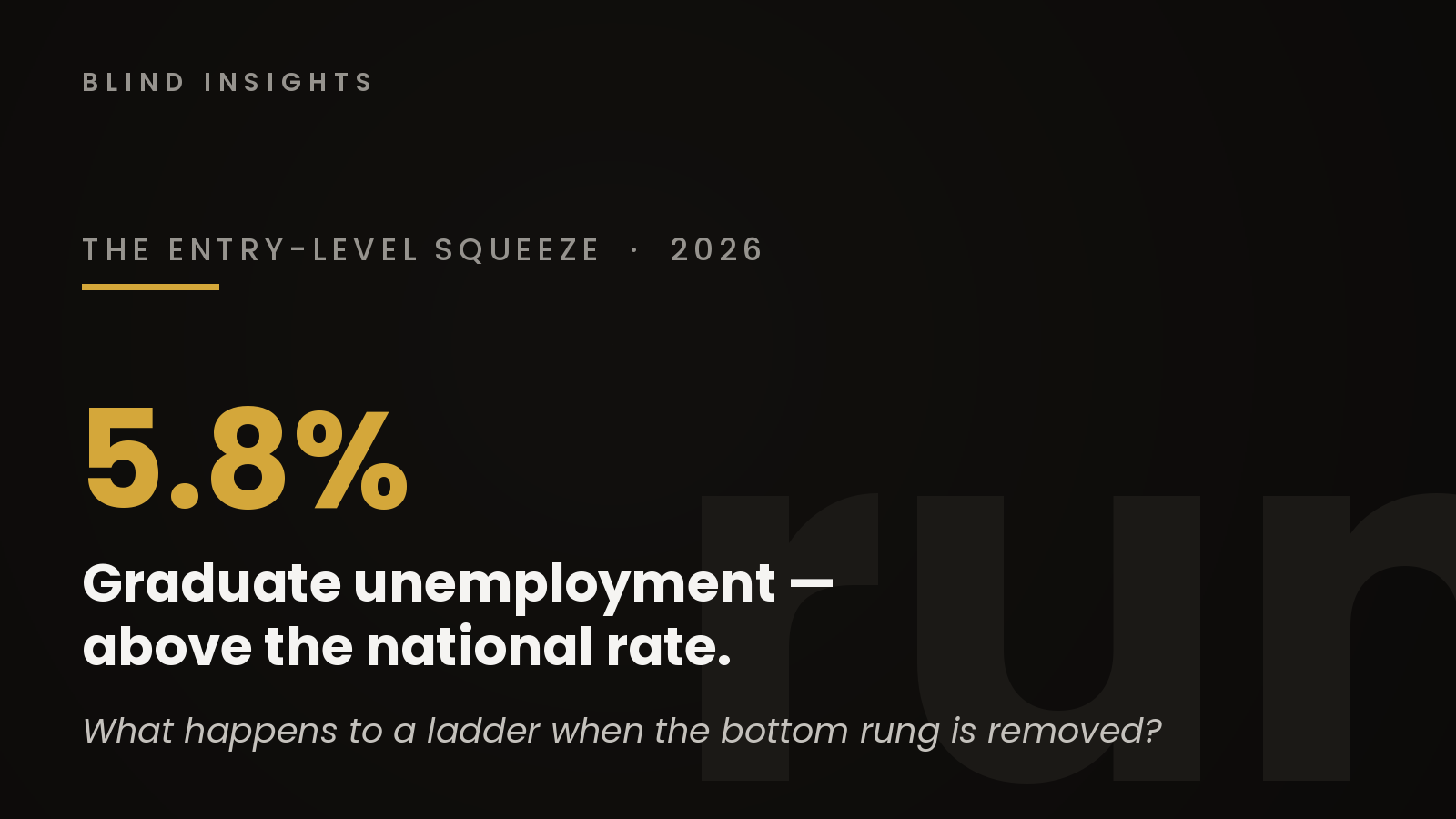
The data is real, if narrower than the panic suggests. Unemployment among recent college graduates has climbed to somewhere around five and a half to six percent — meaningfully above the rate for workers overall, and a reversal of the long-standing rule that a degree buys you a lower jobless rate. Entry-level hiring at the largest technology firms fell by about a quarter in a single year. The junior share of tech hiring has roughly halved since 2023. Layoffs across the sector have run at over a thousand a day, with companies citing AI as the reason.
That is the surface. Underneath it is a structural shift that almost nobody is naming clearly.
The job that AI eats first
Generative AI is not, for the most part, replacing senior people. It is replacing the tasks that juniors used to do to become senior people.
Think about how a career actually works. A junior lawyer reviews documents and drafts simple contracts. A junior analyst builds the first version of the model. A junior developer writes the boilerplate and fixes the easy bugs. None of this work is especially valuable in itself. Its value is that doing it, badly and then less badly, is how a person learns. The grunt work is the apprenticeship.
These are precisely the tasks that today’s AI does competently and cheaply. So a firm looking at its costs makes an entirely rational decision: why hire three juniors to produce first drafts when one experienced person with an AI tool can produce the same drafts faster? The logic at the level of a single quarter is impeccable.
And that is exactly where the problem hides.
The pipeline nobody is pricing
A sixty-year-old idea from economics is suddenly relevant again: learning by doing. Skill is not transferred in a classroom and then deployed. It is built by doing real work, with real consequences, under real supervision. The entry-level job is not a cost to be optimised away. It is the mechanism by which the next generation of experienced workers is manufactured.
Remove the bottom rung of the ladder and the ladder does not get shorter. It gets impossible to climb.
Here is the part the quarterly logic misses. The same firms cutting junior hiring today are, in the same breath, telling investors that their most valuable future asset will be experienced people who can direct AI well. But experienced people are just junior people who survived a decade of doing the work. If you stop hiring and training the juniors now, you are not saving money. You are borrowing it — from your own talent pipeline five and ten years out, at an interest rate you cannot yet see.
The honest complication
It would be too neat to blame AI for all of it, and the honest version of this story refuses to.
Several things are happening at once. Firms over-hired white-collar staff after the pandemic and are still trimming. Global uncertainty — trade tensions, conflict, higher rates — has made every company slower to hire. And one careful analysis found that unemployment in the occupations most exposed to AI was actually lower than in less-exposed ones, which sits awkwardly with the simplest “AI is eating the jobs” narrative.
So the truthful position is mixed. AI is clearly accelerating a shift in what an entry-level worker is for. It is almost certainly not the sole cause of a job market that is also being squeezed by macroeconomics and post-pandemic correction. Anyone selling you a single villain is simplifying for effect.
What this is not
This is not a prediction that white-collar work is ending, nor advice to avoid university, nor a claim that the class of 2026 is doomed. The degree still pays off on average; the data is clear on that. What has changed is that the degree is now necessary and insufficient at the same time — valuable, but no longer a guarantee of the first rung.
The question to keep
So the next time you read that a company has cut entry-level roles “because of AI,” do not stop at the headcount. Ask the structural question underneath it:
If the entry-level job was where experience used to be made — and the entry-level job is what’s being automated — then where, exactly, is the next generation of experienced workers supposed to come from?
We do not have the answer, and we distrust anyone who claims to. But it is the right question, and asking it clearly is the first honest step.
Blind Insights — clarity on money, the economy, and power. We look beneath the surface, because that is usually where the answer is. More at blindinsights.de